Quality Assurance of Fuel Cells
Line scan cameras verify the correct coating of interconnect plates
- Customer
- Elcogen
- Location
- Vantaa, Finland
- Date
- June 2026
Elcogen is a leading manufacturer of combined solid oxide cells and stacks, which can be operated in either fuel cell (SOFC) or electrolysis (SOEC) modes. For the longevity of the solid oxide stack, defect-free components and material layers play an essential role. The vision system, built using Basler line scan cameras, monitors the coating integrity in ferritic stainless-steel components. This is faster, more accurate, and more reliable than manual visual inspection, enabling increased production rates.
Timely error detection ensures durable cell stacks
Defective coatings on an interconnect plate increase the risk of a shorter lifetime for the solid oxide stack. As production rates rise to the gigawatt range, manual inspection methods can no longer be used reliably. With machine vision systems, defective coatings can be detected early so that they are not used in the stack assembly process.
Interconnect plates require a protective coating
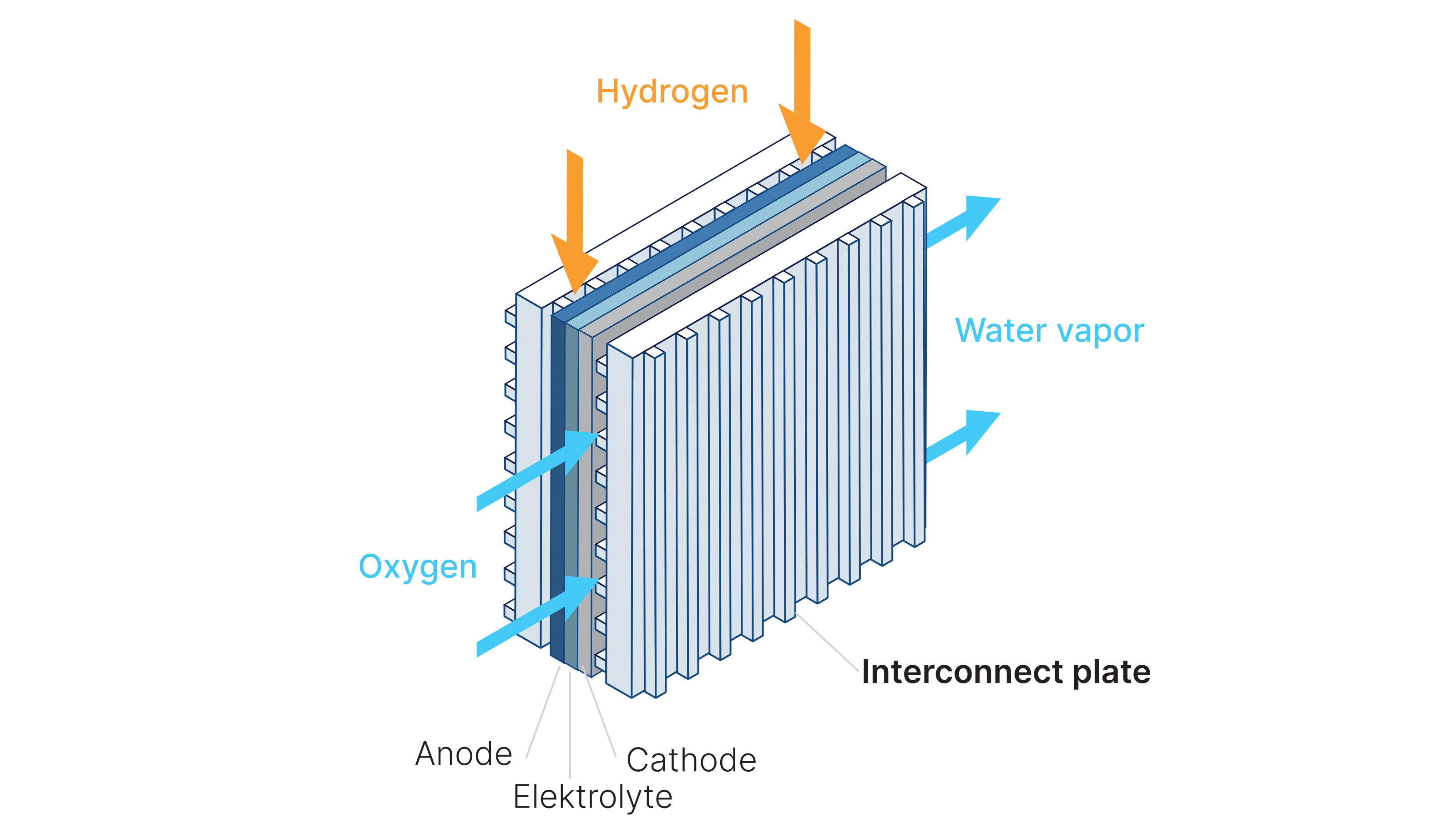
In fuel cell mode, the stack converts the chemical energy of fuel into electrical energy and heat. In electrolysis mode, it splits water into hydrogen and oxygen when energy is supplied. One of the most crucial components is a protectively coated, ferritic stainless-steel interconnect (IC) that connects ceramic cells (elcoCell) in series, enabling 3kW stack configurations (elcoStack).
These plates require complete coating coverage to prevent high-temperature corrosion and chromium evaporation when operating above 650 °C. Without the protection provided by this coating, the cell degradation accelerates, reducing the lifespan of the entire stack. For the longevity and performance of the systems, it is crucial to reliably identify and sort out defective components before the assembly process.
Line scan cameras guarantee the required quality standard
Previously, Elcogen relied on the manual visual inspection of coated interconnect plates. The issue with this approach was that the quality and duration of the inspection depended on the individual. Now, by utilizing a camera-based inspection system, the results are more reliable and reproducible, eliminating the possibility of human error.
Vision system fits into existing production layouts
The vision system should fulfill the following requirements:
Integration into existing production processes
Compact format of the AOI system of 78 cm x 35 cm x 30 cm
Reduced inspection time
Cost-effective implementation
Ability to inspect a single product, four individual products, or an entire product frame
The developed system enables simultaneous imaging of both sides of the coated components. This shortens the inspection time and simplifies the assessment of product quality. The designed product jig ensures seamless inspection of all product variants, without the need for system modifications.
Line scan camera racer 2 convinces
Compact form factor and comprehensive I/O performance
Lateral Engine, the system integrator, was responsible for designing and integrating the vision system. In addition to line lights, which provide homogeneous image illumination, a monochrome line scan camera model was selected: the racer 2 S r2L4096-29gm. This camera is paired with a Basler Lens C11-3520-12M f35mm. Two cameras are installed in the system to inspect both the top and bottom of each component in real time, in a single step. Featuring a GigE interface and the GPixel GL3504 CMOS line scan sensor, the camera delivers a line rate of 29 kHz at 4k resolution. Further advantages include:
Small form factor of 55.5 mm x 29 mm x 29 mm and low weight of 100 g
Internal frequency adjustment: The movement speed of the coated component within the AOI system may vary. The camera enables flexible line rate modifications due to its integrated frequency converter functionality.
From optical requirements to the right camera
racer 2 S with a small pixel size of 3.5 µm
The most important design requirement was to achieve the necessary spatial resolution while keeping the overall size of the system as small as possible. The racer 2 S fulfills these requirements with the following special features:
Compact sensor format: The 3.5 µm pixel size enables a sensor width of just 12.8 mm – ideal for space-saving system designs with C-mount lenses. Compared to cameras with 7 µm pixels, bulky and expensive F-mount lenses with long focal lengths and working distances are no longer required.
Optimal combination of resolution and field of view: The camera achieves a precise spatial resolution of 0.03 mm/pixel with a field of view of 110 mm for high detail accuracy.
Short and practical working distances: With focal lengths of 35 mm, short working distances of approximately 340 mm can be achieved – ideal for C-mount lenses.
With a small pixel size of 3.5 µm, the racer 2 S line scan camera, in combination with suitable optics, creates a compact and mechanically efficient vision system. It meets all requirements in terms of resolution and field of view.

The racer 2 S has fully convinced us both economically and technically. Due to automated inspection being combined with quality control steps on the coated components, we will be able to increase our production rate and improve the stack production quality.

Note: The development was partially funded by the EU.
Camera system for AOI of fuel cells
Our vision solution for the seamless detection of coating defects.
About Elcogen
Elcogen develops and supplies a proprietary solid oxide technology platform that operates in both fuel cell (SOFC) and electrolysis (SOEC) modes. It enables affordable green hydrogen production and zero-emission power generation to drive the clean energy transition. Founded in 2001, the company has its registered office in the UK, its main headquarters in Tallinn, Estonia, and R&D centres of excellence in both Estonia and Finland. Serving a growing global customer base, Elcogen's cells, stacks, and modules are integrated into third-party systems across sectors where decarbonisation is essential, including steel, fuels, shipping, and energy infrastructure. Application-agnostic by design, Elcogen’s technology delivers exceptional efficiency, flexibility, and reliability, unlocking the full potential of renewable energy. Together with its partners, Elcogen is enabling a wider ecosystem of developers to advance the global shift to net zero, bridging today’s energy landscape with a sustainable future.

About Lateral Engine
Lateral Engine Oy is a system integrator specializing in machine vision. Based in Espoo, Finland, the company provides system design, integration, software development, product development, and training services. Its expertise covers a broad spectrum, from the design of imaging configurations to the programming of low-level algorithms.