CXP-over-Fiber
Future-proof image processing with fiber optics
CoaXPress-over-Fiber (CoF) is a high-speed solution for industrial image processing that combines the proven CXP interface with the advantages of fiber-optic transmission. Compared to traditional copper solutions, CXP-over-Fiber enables longer transmission distances, higher bandwidths, and reliable, interference-free signal transmission.
Reading time: approx. 11 Minutes
Key facts about CXP-over-Fiber
CoaXPress (CXP) has established itself as a high-performance interface for machine vision cameras. CXP-over-Fiber is an advanced version that uses optical fibers instead of coaxial cables. Compared to CXP, CXP-over-Fiber offers technical advantages:
Very high bandwidth, currently up to 100 Gbps per camera
Long range of up to 40 km in single-fiber mode: In machine vision, ranges of up to 100 m can typically be achieved in multi-fiber mode without any loss of bandwidth
Immune to electromagnetic interference (EMI) and radio frequency interference (RFI) in production facilities equipped with large electric motors, welding systems, frequency converters, and wireless communication technologies
Flexibly expandable and scalable
Compact and lightweight design utilizing thin cables
What are the advantages of CXP-over-Fiber for vision systems?
By utilizing optical fibers, the interface enables extremely high data rates of up to 100 Gbps per camera over significantly greater distances than conventional coaxial connections. It is immune to electromagnetic and radio interference, making transmission particularly reliable — even in demanding industrial environments. In addition, the bandwidth can be flexibly scaled, enabling efficient support for data-intensive applications such as high-speed or multi-camera systems.
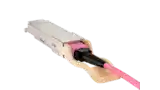
Implementation and integration of CXP-over-Fiber
CoF is based on the established CoaXPress protocol and integrates seamlessly into existing vision systems. The transition from copper to fiber-optic connections — from CameraLink or CoaXPress to CXP-over-Fiber — requires new, future-proof CoF components and optical connection technologies. The software adjustments required for the new system are minimal.
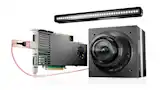
CXP-over-Fiber at Basler
Modern machine vision cameras such as the Basler racer 2 XL line scan camera and the programmable CXP-over-Fiber frame grabber support fiber-optic connectivity without requiring extensive modifications to the system architecture. Basler’s frame grabber SDKs and pylon software— including pylon vTools and AI vTools— andVisualApplets enable intuitive integration, reliable control, and quick commissioning. One example of a complete CoF solution is the TDI vision system, which includes a TDI line scan camera with compatible hardware and software.
About the TDI-Vision system from BaslerA comparison of transmission media: Fiber optics vs. copper
The technical and practical differences between fiber-optic and copper cables in the context of CoaXPress interfaces provide a solid basis for deciding on the optimal solution for your application.
Criterion | CXP-over-Fiber (fiber optics) | CXP (copper) |
|---|---|---|
Maximum bandwidth | 10 Gbps or more per channel | up to 12.5 Gbps per channel |
Maximum cable length | Up to several kilometers in single-fiber mode; in MV, approximately 100 m in multi-fiber mode | Up to about 40 m |
Number of channels per connection | Multiple channels over a single fiber are possible* | Limited quantity, usually 1:1 |
Extensibility | Easily add additional channels/fibers | Limited expandability |
Future viability | Very high (suitable for new generations of cameras) | Limited by physical constraints |
Space requirements | Low (thin cables) | Higher (thicker cables) |
* Note:
A transceiver module currently contains up to 4 channels. 100G is configured as 4x25G, 50G as 2x25G, and 25G as 1x25G. Slower cameras, for example, use only one of the four channels. The possible range extends from "one channel per fiber" up to "four channels per fiber". A so-called 1:4 breakout cable could reconnect 4 "slow" cameras, which are connected via a single channel, to a 4-channel transceiver module in the frame grabber.
Practical considerations for CXP-over-Fiber
In everyday industrial operations, factors such as installation, maintenance, and handling play a crucial role alongside technical specifications. The following points highlight the practical considerations relevant to the use of CXP-over-Fiber in machine vision systems.
Installation and handling
Fiber-optic cables are lighter and more flexible than copper cables. This makes installation easier, especially over long distances and in complex systems. With their smaller footprint and simpler cable routing, they are well-suited for tight or hard-to-reach areas due to their small bending radii, which average 60 mm. One drawback is that optical cables can also break.Costs (initial, maintenance)
The initial costs of a fiber-optic installation are generally higher than those of a copper cable solution. However, over the entire lifespan, the investments often even out, as fiber-optic cables are less susceptible to corrosion and wear and tear, ultimately, requiring less maintenance. Downtime is also minimized due to their higher transmission quality.Flexibility and scalability
With CXP-over-Fiber, systems can be flexibly expanded and adapted to new requirements. Additional cameras or longer transmission distances can be easily implemented without replacing existing infrastructure.Reliability in industrial environments
Fiber optics are immune to electromagnetic interference and radio frequency interference, as well as environmental factors such as humidity or temperature fluctuations. This ensures consistently stable and reliable image data transmission.Easier transport
The low weight of fiber-optic components significantly simplifies transport and reduces system costs.
Latency and signal quality in CXP-over-Fiber
CXP-over-Fiber achieves very low latency and consistently high signal quality—even over long distances. Fiber-optic cables transmit optical signals with virtually no loss and are immune to electromagnetic interference. As a result, the signal remains stable and clear even over cable lengths of several hundred meters. Compared to copper cables, there are virtually no signal reflections, attenuation, or delays that could lower image quality or transmission speed.
Low latency is particularly important for time-critical applications, such as in-line inspection, robot control, or pick-and-place processes. It ensures that image data is transmitted quickly and reliably from the sensor to the evaluation unit. This enables precise process control and high productivity, even in complex systems with long distances between the camera and the evaluation unit.
Fiber optics or copper? Application examples and decision-making guidance
In which scenarios is CXP-over-Fiber recommended, in which scenarios is the standard CXP interface perfectly adequate, and what factors can help guide the decision?

Typical scenarios for fiber optics
CXP-over-Fiber is recommended wherever long distances between the camera and the processing unit need to be bridged or where the highest data rates are required. Typical applications include large-scale production facilities, traffic monitoring, medical imaging, and multi-camera systems. The low-loss transmission and immunity to electromagnetic interference offer decisive advantages in these scenarios. Fiber optics is also the preferred choice in terms of flexible scalability and future-proofing.
Practical example: Efficient image processing through distributed processing on FPGAs and GPUs
TDI cameras continuously generate large amounts of image data — making them ideal for CXP-over-Fiber, which offers up to 100 Gbps of bandwidth. In large-scale production facilities with processing units spread across multiple locations, CXP-over-Fiber enables lossless distribution to multiple frame grabbers without risking bandwidth loss.
A typical scenario illustrates the benefits of an intelligent system architecture:
In the frame grabber, for example, flat-field correction (FFC) is performed as part of the image preprocessing step. In standard systems, this task would be handled by the GPU.
The frame grabbers forward the already optimized image to the GPU. The GPU then only needs to perform image analysis, such as classification for error detection.
The key to this efficient solution lies in the intelligent distribution of processing tasks: global image enhancement and image segmentation—as part of image analysis—are performed on the FPGA. This approach significantly reduces the demands on the GPUs and CPUs of the connected PCs. The higher cost of high-performance frame grabbers is offset by the fact that standard PCs with mid-range GPUs and CPUs are sufficient.
The result: a cost-optimized system with high processing speed and reliability — exactly what CXP-over-Fiber is designed for.

Typical applications for copper
Copper cables, on the other hand, remain a cost-effective option for compact systems with short transmission distances— where the distance between the camera and the frame grabber does not exceed 12–20 m in the CXP-12 standard or 40 m in the CXP-6 standard —and where bandwidth and noise immunity requirements are lower. In these applications, copper solutions offer the advantages of lower upfront costs and straightforward installation.
From a technical standpoint, we recommend using CXP-over-Fiber—that is, fiber optics—whenever high data rates over long distances and maximum immunity to interference are required. For compact systems with short transmission paths, the high-performance CoaXPress interface remains an efficient solution. We would be happy to provide you with personalized advice to help you identify the optimal interface for your machine vision application.

Are you interested in CoaXPress-over-Fiber?
Contact usFuture developments in CXP interfaces
In the field of CXP interfaces, we anticipate several technological advancements in the coming years that will further improve industrial machine vision systems.
CXP technology is constantly evolving and offers a high degree of investment security. Due to its technical advancements, CXP remains a future-proof and high-performance interface for demanding machine vision applications:
1. Higher data rates and new protocol versions
The development of CoaXPress 3.0 and future protocol versions enables even higher bandwidths per channel and supports even more powerful machine vision cameras with higher resolutions and frame rates.
2. Advanced fiber optic integration
We expect the integration of fiber optics into CXP systems to continue to grow. Future cameras and frame grabbers will increasingly offer native fiber-optic connections, making planning and installation even more flexible and further simplifying the process.
3. Improved synchronization and trigger functions
New CXP standards will further optimize the synchronization of multiple cameras and real-time triggering. This is particularly relevant for multi-camera applications and demanding inline inspection processes.
4. Miniaturization and energy efficiency
Future CXP components will be more compact and energy-efficient. This will make it easier to integrate them into space-constrained systems and reduce energy consumption during continuous operation.
5. Advanced software support
Further development of image processing software such as Basler’s pylon software and pylon vTools will make the use of CXP interfaces even more intuitive and powerful. Automated configuration, diagnostic functions, and intelligent error detection will further simplify operation.
6. Standardization and interoperability
Greater standardization in the CXP-over-Fiber sector will further enhance interoperability between different manufacturers and components. This provides additional investment security and facilitates system integration.
Frequently asked questions about CXP-over-Fiber
CXP-over-Fiber enables significantly higher data rates and longer transmission distances than conventional CXP solutions using copper cables. Fiber-optic cables are thinner and lighter than copper cables, which makes installation easier. They are also immune to electromagnetic interference (EMI) and provide stable signal quality, even over distances of several hundred meters. This allows machine vision cameras to be integrated into industrial systems in a flexible and future-proof manner.
With CXP-over-Fiber, transmission distances ranging from several hundred meters to several kilometers are possible, depending on the components used and the quality of the fiber optic cable. In comparison, copper cables typically only support distances of up to 40 m. This makes CXP-over-Fiber particularly suitable for large-scale production facilities and applications where there are significant distances between the camera and the processing unit.
Yes, on the software side, applications can be adapted quickly and easily, as CXP-over-Fiber is based on the CoaXPress protocol. It is generally compatible with existing CoaXPress components, provided that these—such as cameras or frame grabbers—support fiber-optic transmission. Basler’s Frame Grabber SDK and pylon software, as well as pylon vTools, also support CXP-over-Fiber and enable easy integration and control. We would be happy to advise you on the right components for your application.
The upgrade is generally straightforward, as CXP-over-Fiber is based on the same protocol as traditional CoaXPress solutions. All that is required is to replace the fiber optic transceivers, optical cables, compatible frame grabbers, and corresponding cameras. The existing system architecture can usually continue to be used. Basler’s pylon software supports both transmission types — optical and electrical — ensuring efficient integration and configuration.