Inspection of Adhesive Beads on Car Body Parts
Stereo ace 3D camera detects faulty application early and accurately
- Customer
- Mindtrace
- Location
- Manchester, United Kingdom
- Date
- March 2026
When glueing body-in-white (BIW) parts, reliable inline inspection of structural adhesives (adhesive beads) is required to comply with safety guidelines and minimize costly rework. Our stereo ace 3D camera in Mindtrace's vision system meets the requirements for accuracy and cycle time significantly better than manual inspections. It provides a precise 3D structure as a point cloud of the parts and beads, even with low-contrast materials, for subsequent AI analysis.
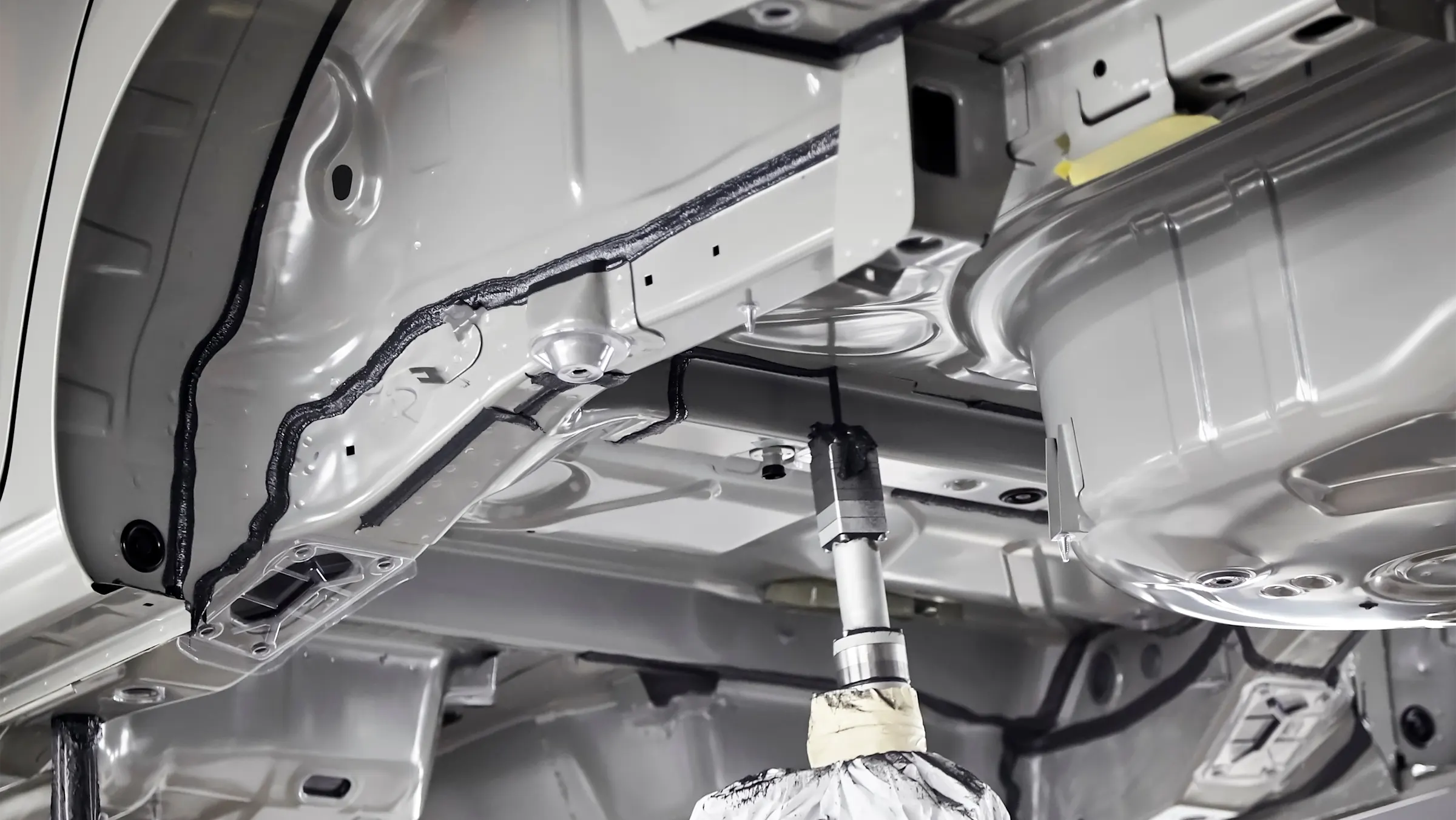
Reliable defect detection through 3D stereo vision in the automotive industry
In fast-cycling body-in-white production lines, the 100% testing of structural adhesives is related to safety. It helps prevent leaks and fulfill NVH (Noise, Vibration, and Harshness) requirements for noise and vibration damping. Vision systems with 3D stereo vision are ideal for real-time inspections of black, transparent, and reflective material types such as black-on-black and clear-on-glass.

Precise decision support during the production cycle
The task of image processing is to evaluate the adhesive beads using vision AI for specified tolerances when they are applied to non-planar body shell parts. Bead geometry including height, width, and continuity along the entire application path as well as the distance to the part edge are all inspected. The 3D recording from a stereo vision camera and the output of a highly accurate 3D point cloud enable the Mindtrace Brain-Sense™ AI to make precise calculations. These form the basis for a deterministic pass/fail decision in real time - including early rejection of faulty parts.
The AI solution also provides additional details on each inspection:
The length of any gaps resulting from interruptions in bead application are measured and reported
The adhesive bead is segmented in green and parts of the bead line are marked in red if the distance to the edge is outside the tolerance.

Why is 3D stereo vision suitable for inspecting adhesive beads?
Volumetric consistency: In contrast to 2D cameras, stereo cameras calculate the actual height (Z-axis) of the adhesive bead. This allows the system to detect thinning before it becomes a gap.
Glare resilience: By comparing two viewing angles, stereo cameras ignore glare from reflective parts that a single 2D camera would experience.
Flexibility for varying car model ranges: A wide field of view and large depth of field minimize the robot's changeover times. The robot only needs to reposition itself slightly for parts of different heights.
Processing times: 3D line scanners and laser technologies scan an area point by point. In contrast, stereo cameras generate a complete 3D image from depth information in just a few seconds.
3D stereo vision outperforms 2D cameras and 3D laser profile measuring devices
The stereo vision system has clear advantages in terms of price, speed, material variety, and surface quality compared to manual inspections, 2D solutions, and 3D laser technologies such as profile sensors. 2D solutions are too inaccurate for non-planar parts, reflective surfaces, and low-contrast materials. 3D profile sensors and manual inspection already fail due to the fast cycle times in production. However, costly rework and subsequent recalls should be avoided at all costs in the fully automated factory. Any delay in a single production cell can bring the entire production process to a standstill. Stereo vision outperforms other inspection methods with a very low error rate of less than 0.5 percent.
Vision system with Basler Stereo ace: reliability and efficiency in part inspection
In the vision system, the Basler Stereo ace provides an exact and comprehensive 3D and color capture of each part in just one shot. Together with Mindtrace AI and the NeuroForge™ production cell, the camera inspects even complex surfaces in a matter of seconds and reliably detects defects. Rejections and rework can be controlled efficiently without major delays in the production flow.

Thorough quality control - in seconds
The Basler Stereo color camera (consisting of two standard RGB cameras) is integrated directly into the production cell. A robot presents a part to the camera every 40 seconds. The NeuroForge™ production cell captures the entire part in just one image acquisition, which enables deeper quality analyses of the complex, free-form surfaces than with 3D profile sensors. These miss anything outside their narrow laser line if the robot or part moves too much. The stereo camera delivers a highly accurate 3D point cloud and RGB images to the Mindtrace AI, which reliably identifies and differentiates the quality of the bead application.
The AI detects deviations from predefined tolerances such as gaps along the adhesive bead or its incorrect distance from the edge. It decides within 5 seconds whether the part should be rejected. This is a significant improvement on the current process. In addition, there is now enough time to check and install an alternative part within the cycle time if a part is rejected.

Highest camera precision for 100% defect detection
When selecting the camera, Mindtrace relied on our technical expertise and the British distributor OEM Automatic. The Basler Stereo ace 100 color camera STA-100-547C-082609-W selected for the application has a baseline of 100 mm between the two Basler ace 2 RGB cameras, each with 5 MP resolution. It covers a flexible working range of 0.6 m to 2 m and achieves depth resolutions of 0.10 mm to 1.13 mm. The GigE camera can be quickly integrated into existing production environments thanks to our pylon SDK software.
High measuring accuracy thanks to factory calibration and dynamic self-calibration routines
Reliability with demanding surfaces thanks to an integrated LED pattern projector, even in ambient light and standard LED light
Minimum latency for shorter cycle times
Wide field of view and great depth of field for precise part detection
Stereo vision is the best choice for inline inspection in the automotive industry with robotic systems. It generates the 3D data required for safety-critical adhesive beads with the speed and flexibility of a standard camera system.

The Basler Stereo camera delivers precise, high-resolution 3D data in the production cycle. We were able to accurately measure the adhesive bead in a single shot, even on reflective and low-contrast surfaces. This is more reliable than with 2D or laser-based systems.

Scalability and advantages of the inspection solution
Following its successful use in adhesive bead inspection, there are plans to extend the solution to other customers in the automotive manufacturing industry. In addition, new application areas such as surface defect detection (dents, dings) and other depth-based inspection tasks will be developed. The following advantages of the implemented stereo vision solution come into effect:
Reduction in labor costs due to elimination of manual inspections
Minimization of reject, rework, and recall costs
Increase in initial production quality and production throughput
Our 3D stereo vision camera for this vision solution

About Mindtrace
Mindtrace Ltd., headquartered in Manchester, United Kingdom, is an industrial AI pioneer transforming smart manufacturing. Its Brain-Sense™ AI platform achieves 98%+ detection accuracy, virtually eliminating defects while reducing costs. Partnering with global leaders, Mindtrace delivers end-to-end computer vision solutions that turn complex data into actionable factory-floor productivity.