Vision for Die Bonding: What Changes When Tolerances Stop Forgiving Mistakes
Stable alignment and inspection inside high speed die bonders
Modern die bonders concentrate multiple vision tasks into compact, high-speed, and thermally unstable environments. As package density increases and bonding tolerances tighten, the challenge is no longer camera and optics selection. It's building a vision architecture that holds synchronization stability, imaging consistency, and process control across an entire production run.
Addressing three key vision challenges in modern die bonding process
Traditional die attach remains the volume backbone of semiconductor packaging. At the same time, flip-chip, thermocompression, and hybrid bonding are pushing overlay tolerances into ranges where imaging instability directly affects yield. Most engineering teams aren't transitioning between these workflows. They're running both in parallel.
Across both, thinner substrates, reflective surfaces, buried fiducials, and heated bonding environments make stable image acquisition progressively harder under continuous production conditions.
1. Maintaining imaging stability under high-speed bonding motion
At fine pitch and high throughput, the problem isn't only image sharpness; it's whether acquisition timing is deterministic enough to be trusted across thousands of bonding cycles. Reliable frame delivery and consistent acquisition timing under continuous high-speed motion are where vision system stability is won or lost. A dropped frame at the wrong moment means a misplaced die.
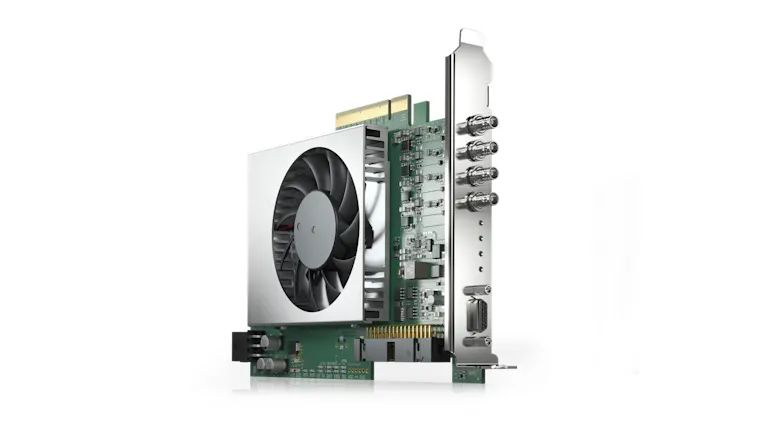
For workflows requiring tighter synchronization or onboard image preprocessing, Basler offers FPGA-based processing at the camera level or frame grabber level, reducing CPU load without adding external hardware complexity.
Die bonding systems today vary widely in throughput, camera count, latency sensitivity, and existing vision architecture. Basler supports these evolving requirements through stable image acquisition, synchronized triggering, and scalable preprocessing architectures across multiple interface platforms.
Discuss your bonding requirements with a Basler engineer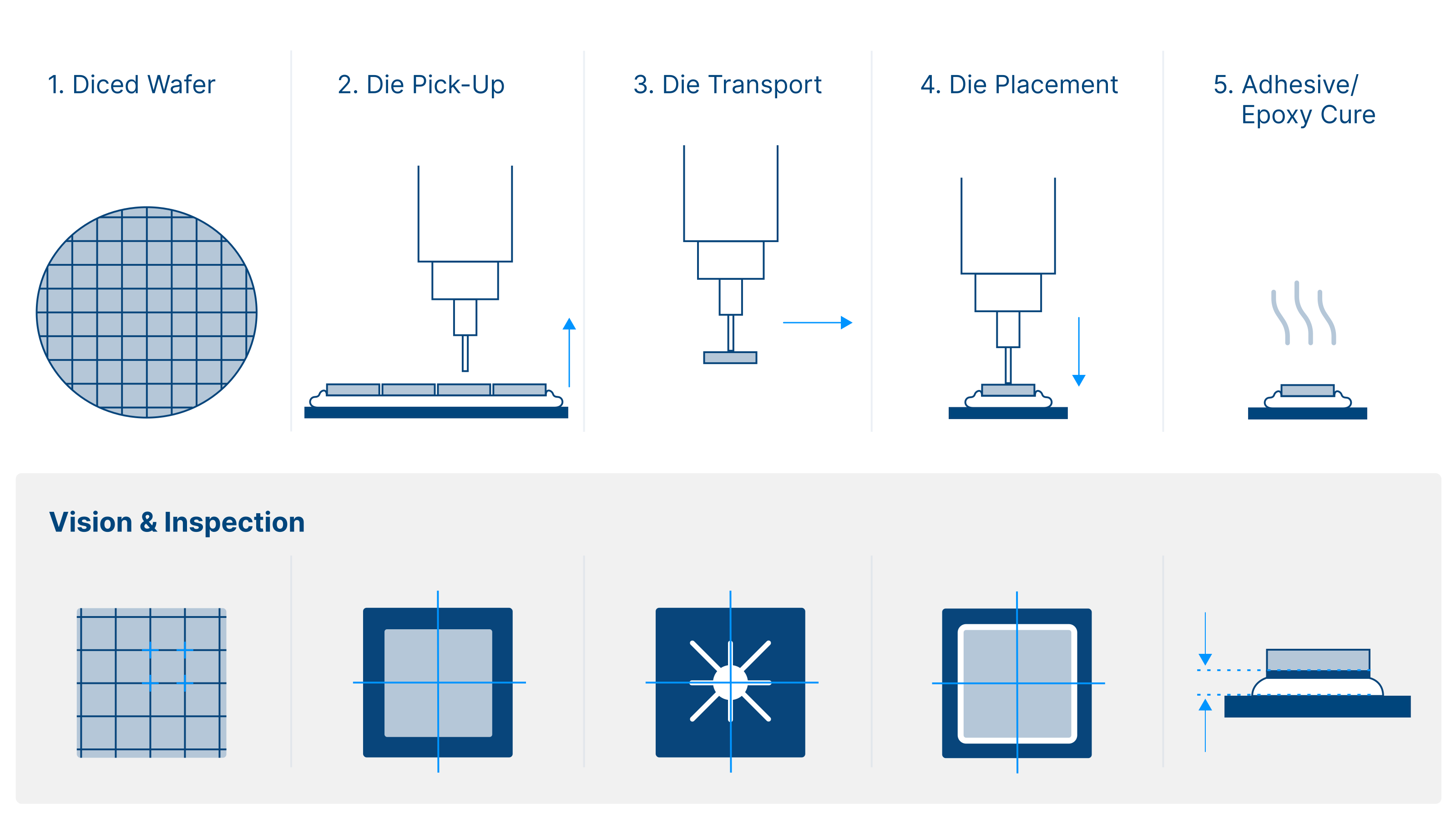
2. Ensuring reliable image quality across different materials, surfaces, and package structures
Reflective leadframes, dark organic substrates, transparent epoxy, and buried fiducials aren't variations of the same imaging problem. Each requires a different approach, and a vision architecture that handles one well won't necessarily handle the others without configuration changes.
For standard surface fiducials and placement verification, visible light imaging with consisten glare control handles standard surface fiducials and placement verification across traditional die attach workflows.
For buried structures beneath silicon, passivation, or epoxy, which are increasingly common in die-to-wafer and heterogeneous integration, Basler ace 2 X visSWIR cameras leverage silicon's transparency at SWIR wavelengths to make hidden fiducials visible without any process modification.
Talk to our experts about SWIR-based alignment approaches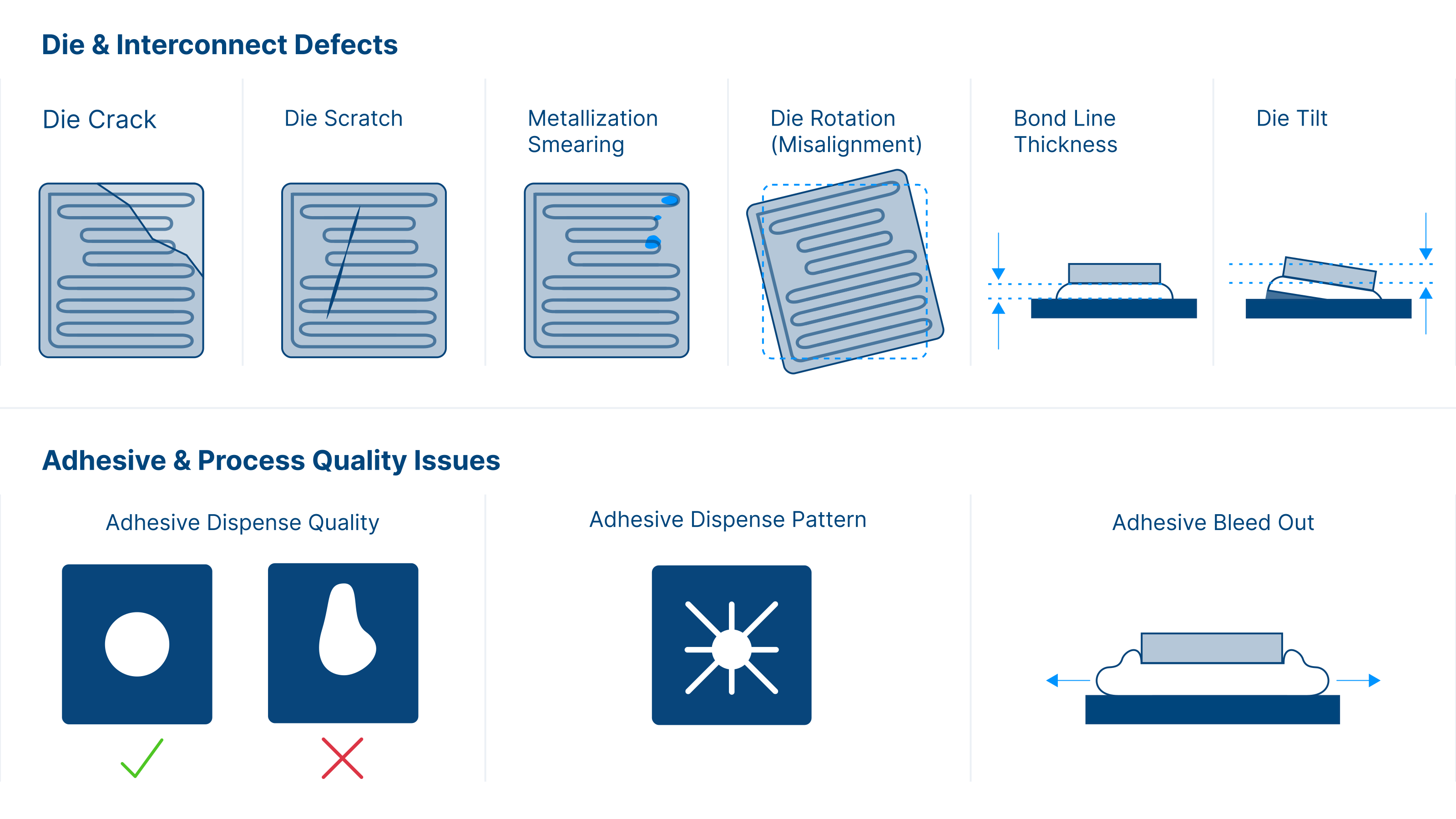
3. Process and tool condition monitoring
As tolerances shrink, vision is being pulled further into the bonding control loop: monitoring bond-head position, nozzle condition, epoxy consistency, bond-line variation, and thermal drift throughout the cycle, not just verifying placement after the fact.
The imaging challenges here are specific. Thermal expansion during heated bonding shifts fiducial positions continuously. Vibration, and mechanical loading can introduce positional offset variation that directly affects placement accuracy and bond-line consistency.
As a result, more bonding platforms now deploy dedicated vision systems for monitoring tooling and process state in real time. For these applications, stable triggering, repeatable contrast performance, and deterministic image acquisition become critical for maintaining positional consistency under changing thermal and mechanical conditions. In compact bonding platforms, flexible integration and synchronization stability are often just as important as imaging performance itself.
Thermocompression and hybrid bonding are driving alignment complexity that traditional vision architectures weren't designed for. Multiple stacked dies in HBM and heterogeneous integration workflows demand tighter synchronization stability, continuous process monitoring, and buried fiducial visibility. With our broad product portfolio, vision solution capabilities, and proven industry reliability, we are actively and continuously supporting our semiconductor customers' evolving requirements.

Supporting the transition toward advanced packaging
Traditional die attach workflows remain widely used across automotive, power semiconductor, industrial, and sensor packaging applications. At the same time, flip-chip, thermocompression bonding, and hybrid bonding are pushing die bonders toward tighter overlay requirements, higher throughput, finer-pitch alignment, and increasingly complex thermal conditions.
As bonding workflows continue evolving, synchronized acquisition, buried fiducial imaging, deterministic image handling, and continuous process monitoring are becoming increasingly important across advanced packaging applications.
Learn about our vision approach for hybrid bondingVision integration inside die bonders made easy
Modern die bonders require stable imaging, synchronized triggering, and flexible integration within compact and thermally unstable environments. Basler supports these requirements through:
Synchronized image acquisition for stable alignment at high throughput
Compact and flexible integration within mechanically constrained bonding platforms
SWIR and FPGA-based vision architectures for advanced alignment workflows
Products for this solution
Looking to implement a comparable solution? These products will help you.