Extending Photometric Stereo to Reveal 3D Surface Features of Moving Objects
Photometric stereo is a proven machine vision technique that reveals 3D surface defects independently of printed patterns or textures. However, this method is limited to stationary objects. Basler leverages IMX900 sensor design of Quad Shutter Control and enables high-precision photometric stereo imaging on moving parts.
What is photometric stereo and why is it difficult to use on moving objects?
Photometric stereo seperates surface topology from 2D features
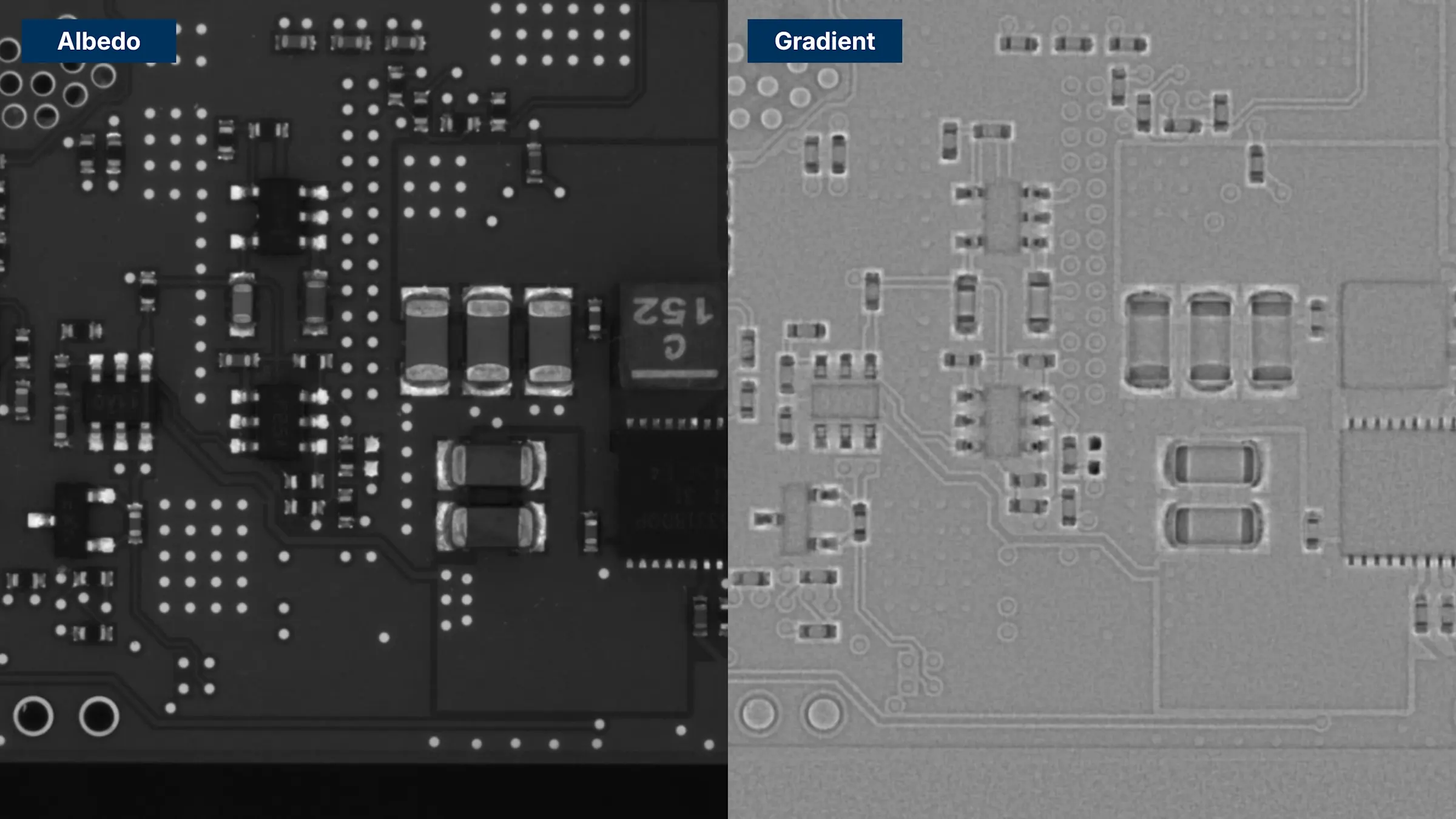
Photometric stereo is a machine vision technique used to reveal subtle surface defects such as dents, cracks, scratches, and deformations. Unlike conventional 2D imaging, it evaluates surface geometry rather than surface appearance, making it highly effective for inspecting products with printed graphics, labels, textures, or varying colors.
Photometric stereo implementation and limitations
The technique works by capturing multiple images under different illumination directions and analyzing the resulting shading information to reconstruct the surface shape. By separating surface geometry from appearance, photometric stereo can reveal defects that may otherwise be hidden by printed patterns or texture variations.
However, conventional photometric stereo requires multiple images of the same object position. When inspecting moving objects, even small displacements between image captures can introduce reconstruction errors and reduce inspection reliability. As a result, photometric stereo has traditionally been limited to stationary objects or stop-and-go production processes.
Quad shutter control: Capturing four illuminations within a single frame
Basler brings the Quad Shutter Control sensor function in Sony's IMX900 image sensor to the next level by enabling the capture of four illuminations within a single frame.

Extending photometric stereo to moving object inspection
Basler extends photometric stereo to moving-object inspection through a customized implementation of Quad Shutter Control based on Sony's IMX900 sensor. The technology enables four independently controlled exposure timings within a single acquisition cycle.
In conventional systems, the four images required for photometric stereo are captured sequentially, creating a time gap between acquisitions. When objects are moving, this gap introduces positional differences that can affect reconstruction accuracy.
With Quad Shutter Control, the four exposures are performed within microseconds of one another and synchronized with four directional light sources. This dramatically reduces the effective acquisition interval and allows all required photometric stereo information to be captured while the object remains effectively in the same position.
As a result, reliable photometric stereo imaging can be achieved while the object remains in continuous motion, preserving inspection accuracy without requiring the object to stop.
Precise exposure timing for motion-consistent imaging
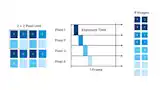
Quad Shutter Control enables the exposure start timing of each pixel within a 2 × 2 pixel group to be controlled independently. As a result, four separate exposures can be captured from a single acquisition trigger, providing the foundation for photometric stereo imaging of moving objects.
Quad Shutter Control enables the four image acquisitions required for photometric stereo to be performed within an extremely short time window while the object remains effectively at the same position.
For example, a conventional 100 fps camera requires approximately 10 ms between consecutive image captures. By contrast, the Basler implementation allows four exposure timings to be controlled within a single image acquisition at microsecond-level intervals.
When combined with synchronised control of four directional light sources, the effective acquisition interval between the required images can be reduced to nearly zero. This removes the primary bottleneck of conventional photometric stereo systems and enables inspection of moving objects using photometric stereo techniques.
Interested? Discuss your needs with usThe key challenge in photometric stereo is maintaining geometric consistency between images captured under different illumination directions. Quad Shutter Control significantly reduces the acquisition interval, allowing reliable surface reconstruction even when the object is moving
Bringing photometric stereo to high-speed production lines
With Quad Shutter Control, manufacturers can extend the benefits of photometric stereo to applications that were previously impractical due to object motion and throughput constraints.
Inspect moving objects without stopping production
Detect true surface defects independent of print, color, and texture
Maintain inspection reliability while preserving line throughput
Typical applications include products with printed graphics, labels, or textured surfaces where conventional 2D inspection may struggle to distinguish appearance variations from true surface defects.