Glassless UV Sensors
Customized UV imaging for specialized optical requirements
Ultraviolet (UV) imaging helps reveal surface defects and material characteristics that are difficult to detect under visible light. However, even UV-sensitive cameras can encounter imaging challenges caused by unwanted reflections, optical artifacts, or wavelength-dependent transmission losses. In certain optical configurations, the sensor's protective cover glass may contribute to these limitations.
Glassless UV sensors offer an alternative by removing the cover glass and its associated optical interfaces. For applications with specialized imaging requirements, Basler provides customized UV camera solutions to help address optical challenges beyond standard camera configurations.
Reading time: approx. 7 Minutes

Key points about glassless UV sensors
Reduced reflective interfaces: Removing the cover glass eliminates optical surfaces that may contribute to unwanted reflections or ghosting.
Improved UV light transmission in suitable configurations: Removing the cover glass may reduce wavelength-dependent attenuation, particularly where the glass material limits short-wavelength UV transmission.
Application-specific image optimization: Glassless configurations may help address cover-glass-related optical artifacts in demanding UV imaging systems.
UV wavelength considerations: Sensor sensitivity, cover-glass transmission, illumination, and optics must be evaluated together to achieve suitable imaging performance.
Customized Basler solution: Glassless customization can be evaluated according to specific application requirements and technical feasibility after consultation with our team of experts.
Why standard UV cameras may face imaging challenges
UV-sensitive cameras are designed to capture shorter wavelengths than conventional visible-light cameras. They are particularly useful when differences in material properties or surface characteristics produce contrast under UV illumination. However, UV-sensitive sensors alone do not guarantee optimal imaging performance. The complete optical system, including the lens, illumination, filters, and sensor cover glass, influences the final image.
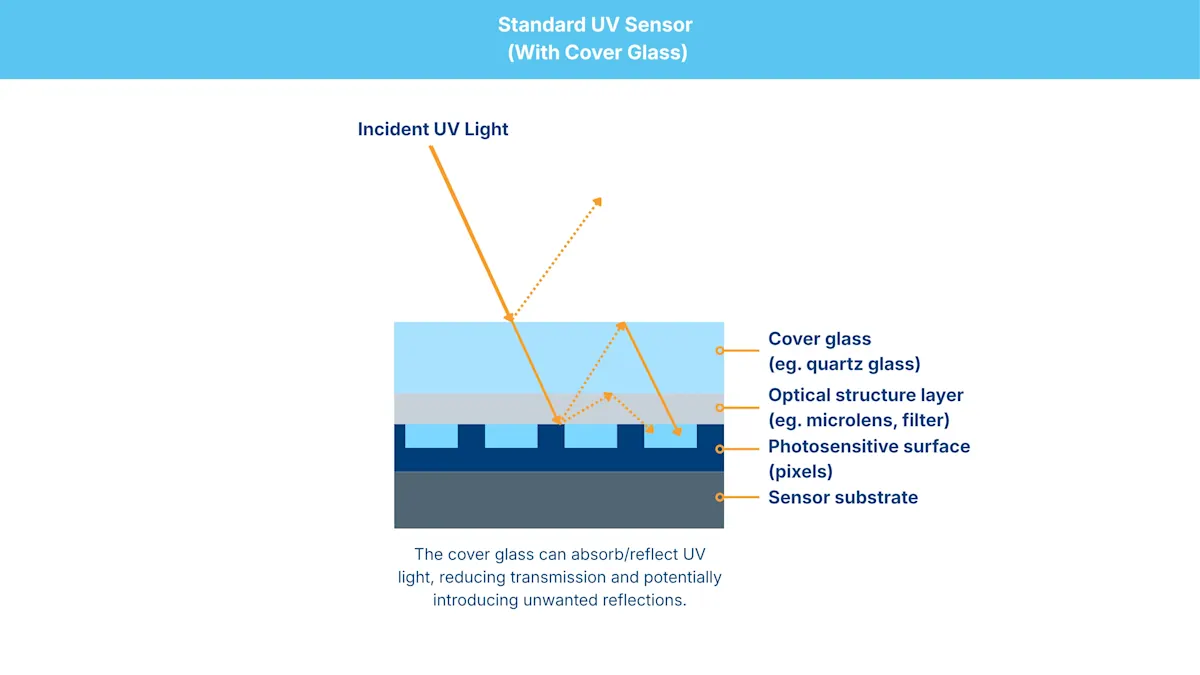
One potential challenge is unwanted reflections from optical interfaces. When UV light passes through the sensor cover glass, a portion may be reflected at its surfaces. Depending on the optical configuration, these reflections can contribute to ghosting or reduce image contrast.
Transmission characteristics also vary across the UV spectrum. Even when a sensor is UV-sensitive, other optical components may attenuate certain wavelengths, reducing the amount of light reaching the photosensitive surface.
These challenges become particularly relevant when inspecting low-contrast features or working with demanding optical configurations.
How does cover glass affect UV imaging?
The protective cover glass of an industrial image sensor serves an important function: shielding the sensitive sensor surface from contamination, dust, and mechanical damage.
UV sensors use specially selected materials to maintain transmission at ultraviolet wavelengths. For example, the IMX487 sensor used in the standard Basler ace 2 X UV cameras is designed for approximately 200–400 nm UV sensitivity and incorporates UV-compatible cover-glass materials.
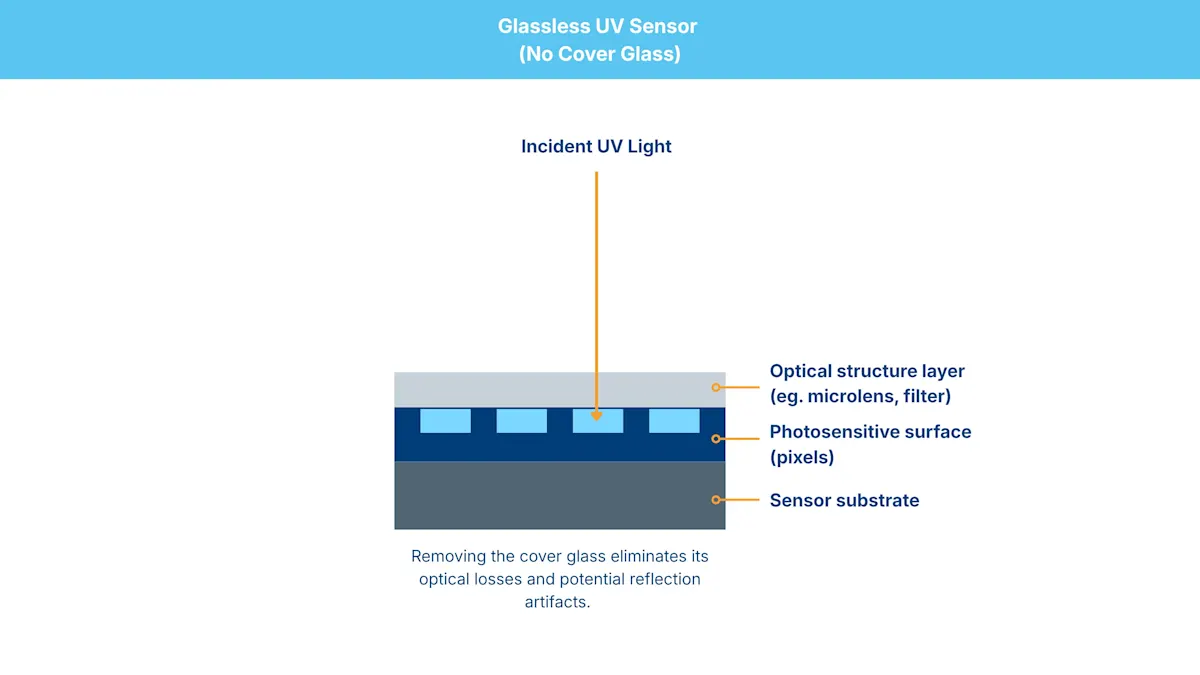
Nevertheless, even UV-compatible glass introduces additional optical interfaces. Reflections at these surfaces can create unwanted optical paths, potentially affecting image quality in certain imaging configurations. Removing the cover glass eliminates these interfaces, which may help reduce cover-glass-related reflections or ghost images. However, the actual improvement depends on the illumination geometry, operating wavelength, and optical arrangement.
When should a glassless UV sensor be considered?
A glassless UV sensor may be considered when the cover glass introduces optical limitations that affect inspection accuracy, particularly in applications requiring high contrast and sensitivity to extremely small defects.
Two key considerations:
Unwanted reflections and ghosting: Reflections between the front and back surfaces of the cover glass can contribute to stray light and ghost images, reducing image contrast. These effects may become particularly relevant when inspecting subtle surface features, phase defects, or haze in micro- and nanoscale inspection applications.
UV wavelength-dependent transmission losses: Cover-glass materials can absorb or attenuate certain UV wavelengths, particularly in the shorter-wavelength region. Where transmission is limited, fewer photons reach the sensor, potentially reducing the effective system sensitivity and signal-to-noise ratio.
Removing the cover glass eliminates these additional optical interfaces and may improve UV light throughput where cover-glass transmission is a limiting factor. However, the benefits depend on the glass material, operating wavelength, and overall optical configuration.
Basler's customized glassless UV camera solution
Not every UV imaging requirement can be addressed with a standard camera configuration. Basler offers application-specific customization for selected cameras, including glassless sensor options, to help overcome specialized optical challenges.
Beyond camera customization, Basler combines extensive machine vision expertise with a comprehensive portfolio of cameras, optics, illumination, and software to support the development of suitable imaging solutions. From evaluating optical requirements to supporting system integration, Basler helps customers address imaging challenges while reducing development complexity and ensuring compatibility with their industrial vision systems.
Selecting the right UV imaging configuration
Choosing between a standard UV camera and a glassless configuration requires evaluating the complete imaging system. Although removing the cover glass eliminates additional optical interfaces, it does not guarantee better imaging performance in every application. Sensor sensitivity, optical transmission, illumination geometry, and environmental protection must all be considered.
For many applications, standard UV cameras with UV-compatible cover glass provide a practical solution. Where specific optical limitations justify customization, a glassless configuration may offer an alternative.
Basler supports customers in evaluating these requirements and identifying suitable UV camera configurations for specialized industrial inspection tasks.
Contact us about UV camera customization

