Deep UV Imaging for Reliable Inspection of Transparent Materials
Transparent materials such as adhesives and resins are difficult to inspect using conventional machine vision, as their optical properties often result in insufficient image contrast. By combining 280 nm deep ultraviolet (DUV) light with Basler UV camera technology, transparent materials can be visualized more clearly, supporting automated inspection with greater flexibility in system design.
Why are transparent materials difficult to inspect?
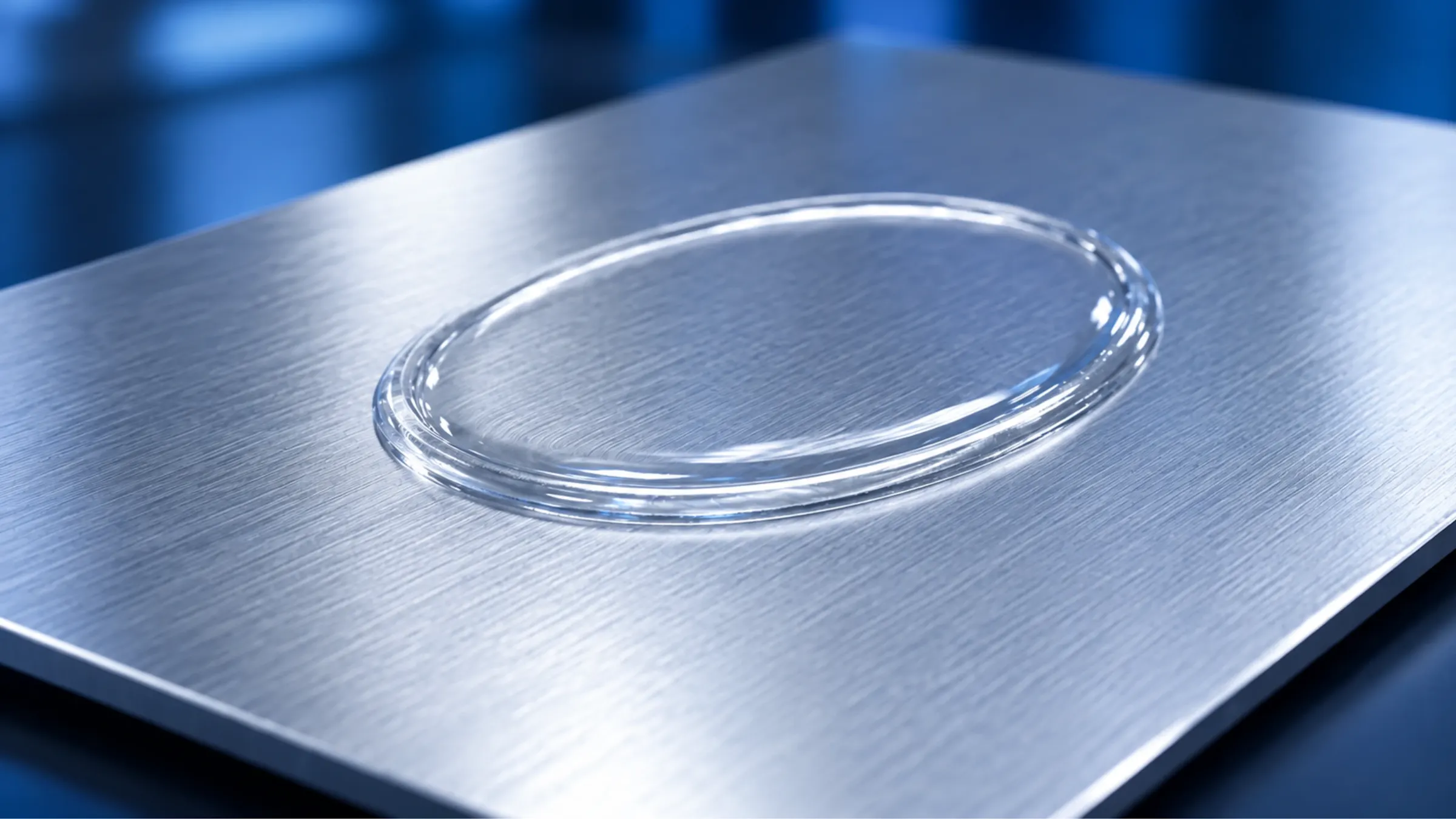
Transparent adhesives and resins are widely used in industrial manufacturing, where verifying material presence, distribution, and application quality is essential. However, their transparency presents a challenge for automated optical inspection.
These materials transmit much of the light in the visible spectrum (approximately 400–780 nm). When applied to a reflective surface, such as aluminum, the reflected light from the substrate can dominate the captured image, resulting in poor contrast between the material and its background.
Although adjusting the illumination or viewing angle can improve visibility, industrial vision systems often require fixed camera positions for consistent image acquisition. In challenging applications, additional lighting arrangements or multiple viewing directions may be necessary, increasing system complexity, inspection time, and equipment costs.
How DUV lighting makes transparent materials visible
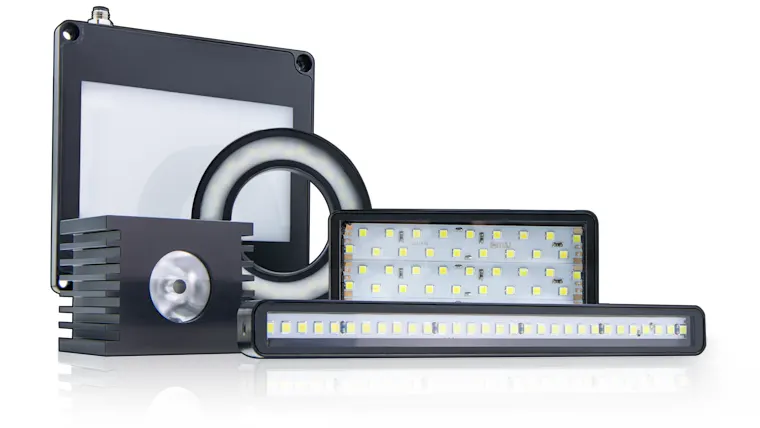
Unlike visible light, Deep UV light at approximately 280 nm is more strongly absorbed by certain transparent adhesives and resins, while a reflective substrate such as aluminum reflects it back to the camera. This wavelength-dependent behavior makes the material appear dark against a bright background.
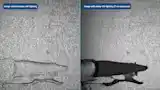
Visible light vs. DUV: improved adhesive contrast
The comparison demonstrates how selecting an appropriate wavelength can significantly improve image contrast without changing the camera's viewing position.
In the demonstrated application, Deep UV light at 280 nm makes the transparent adhesive clearly distinguishable from the aluminum substrate, with an exposure time of just 1 ms. This highlights the potential of DUV imaging for applications requiring both high contrast and short image acquisition times.
Improved contrast also provides a clearer basis for subsequent image processing, such as adhesive presence verification, boundary detection, and area measurement.
Inspecting transparent materials? Discuss your application
Basler ace 2 X UV camera: Capturing image details beyond the visible spectrum
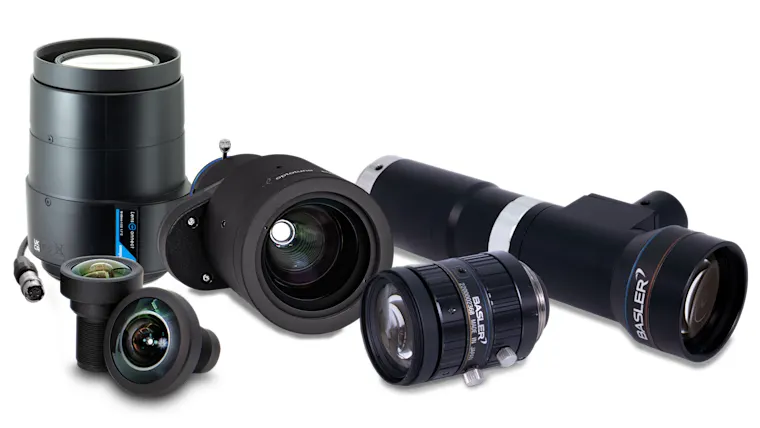
Deep UV light alone is not sufficient for effective image acquisition. Conventional industrial cameras and lenses are generally optimized for visible light and may have limited sensitivity or optical transmission at 280 nm.
The Basler ace 2 X UV camera, featuring the Sony Pregius S IMX487 sensor, offers sensitivity across the 200–400 nm ultraviolet range. With 8.1 MP resolution and a global shutter, it supports detailed image acquisition for industrial UV inspection applications.
Combined with UV-transmitting optics and DUV light, the camera enables the capture of image contrast that would otherwise be difficult to achieve with conventional visible-light systems.
For reliable performance, the camera, lens, and illumination must be selected together, considering the material's absorption characteristics, substrate reflectivity, optical transmission, and inspection geometry.
Inspecting transparent materials is not always about increasing camera resolution. The real challenge is generating sufficient contrast. By combining 280 nm Deep UV light with a UV-sensitive camera and suitable optics, we can make adhesive patterns visible that are difficult to distinguish under conventional lighting. This gives engineers a more reliable starting point for automated inspection.
Benefits of DUV imaging for automated inspection
By making transparent materials more distinguishable from their backgrounds, DUV imaging opens up new possibilities for industrial quality inspection.
Improved visibility of transparent materials: Higher image contrast supports inspection of adhesive presence, distribution, boundaries, and coverage.
Greater flexibility in vision system design: DUV imaging can improve material visibility from a fixed camera position, potentially reducing the need for additional viewing angles or complex inspection arrangements.
Potential for shorter inspection cycles: The demonstrated 1 ms exposure time highlights the potential of DUV light for applications requiring short image acquisition times.
Beyond adhesive inspection, the same imaging principle may be applicable to other transparent resins and glass materials, depending on their UV absorption characteristics, the substrate and the inspection requirements.
Products for this solution
Looking to implement a comparable solution? These products will help you.