GigE Vision 3.0
The latest update of the GigE Vision standard enables even faster data transmission
GigE Vision 3.0 is currently being developed by the A3 organization and its GigE Vision Technical Committee, on which Basler also participates. The new version takes advantage of the advances in Ethernet hardware and the RoCEv2 protocol. In this way, it improves speed and latency in image processing and industrial automation.

Key points about GigE Vision 3.0
Reduced CPU utalization: System resources are freed up for other tasks and the overall performance increases
Multi-camera systems become more powerful and reliable
RoCEv2 ensures more consistent and reliable data transmission, minimizing interruptions in critical applications, among other things
RoCEv2 connections provide higher data transfer rates. This enables imaging systems to handle larger data volumes and scale efficiently scalability in latency-critical applications.
The low latency improves the responsiveness of the system, making it ideal for robotics and automation
Compatibility and interoperability: The current GigE Vision control protocol is remains unchanged retained,ensuring a seamless transition. Existing software requires only minimal modifications.
GigE Vision 3.0: direct data path for greater efficiency
GigE Vision 3.0 combines high-performance cameras and modern Ethernet infrastructure into a more efficient data path: The camera transmits image data directly to RAM via RDMA using a RoCEv2-capable network card. The CPU does not need to store or copy image data. This reduces processing overhead and enables high data rates, low latencies, and scalable vision systems.
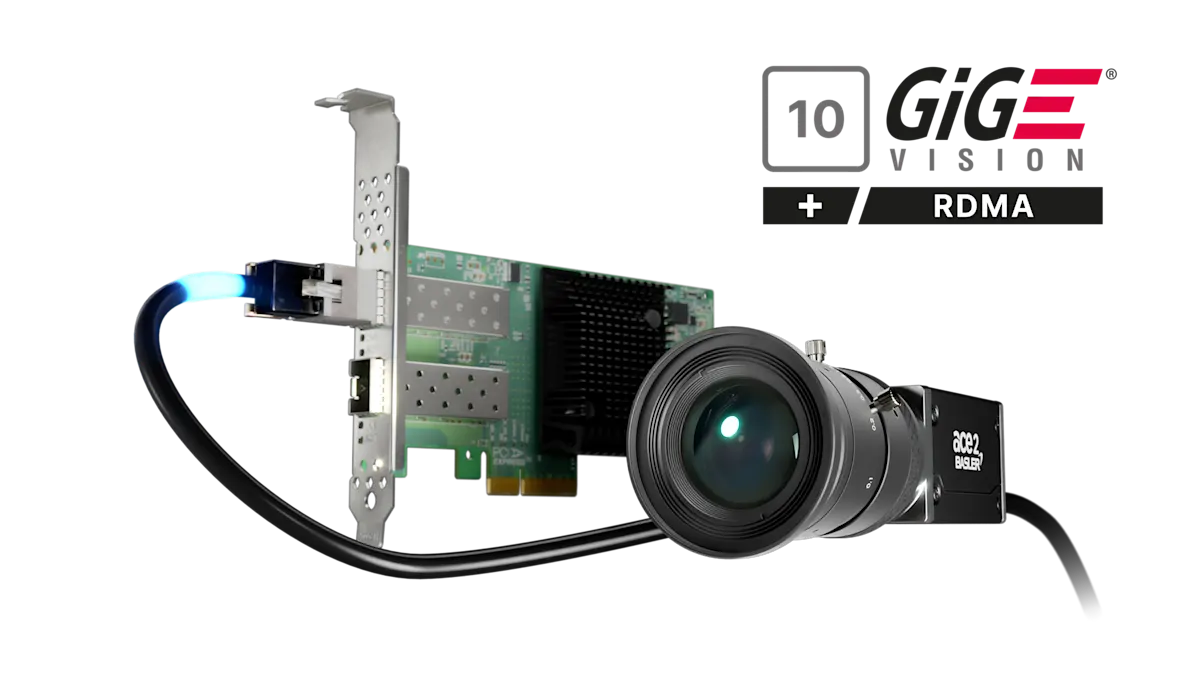
Our products with GigE Vision 3.0
Designed to work together for efficient data transfer: ace 2 cameras with 10GigE performance, compatible RDMA-capable network interface cards (RNICs), lenses, and high-performance Cat6a cables make up the components of a high-performance GigE Vision 3.0 system.
Products with GigE Vision 3.0RoCEv2 enables lean transmission of image data
With RoCEv2 transmission, image data packets are received directly by the NIC and stored in the target system’s memory—without intermediate buffering and additional copying by the CPU. The NIC handles a significant portion of the data transfer, while the CPU remains available for other tasks.
Direct memory access reduces processing overhead and latency, enabling reliable transmission of large amounts of data. The loss of image data packets is eliminated.
The amount of buffer memory required on the camera side is also reducedsince the image data is transmitted without additional caching.
GigE Vision 3.0 creates a direct data path from the camera through the RDMA-capable NIC to RAM—bypassing the CPU as the processing unit for the image data packets.
Minimal latency with the new RoCEv2 streaming protocol
The new key feature of GigE Vision 3.0 is the integration of RoCEv2 (RDMA over Converged Ethernet Version 2) for data streaming. As an alternative streaming protocol, RoCEv2 complements the existing GVSP and enables RDMA-based transmission of image data. GigE Vision 3.0 is designed as an extension of Version 2.2 rather than a replacement. The existing GigE Vision control protocol remains unchanged, allowing existing systems and software to continue to be used with minimal modifications.
Bypassing the CPU has a double effect: first, it eliminates a source of error, and second, it frees up system resources for other tasks. Overall, GigE Vision 3.0 has the potential to reduce overall system costs.

The RoCEv2 protocol, originally developed for extremely demanding environments, is a multiplier that reinforces all the advantages of GigE Vision at the same time: Thus, the GigE 3.0 version will become highly important for the machine vision market in the long term.

Basler drives the development of GigE Vision 3.0

GigE Vision 3.0, a major update to the established standard, was released in May 2026. A3, the U.S.-based Association for Advancing Automation is responsible for this update.
Michael Schmidt, Senior Product Architect at Basler, played a key role in the development of these technical innovations. As Basler’s representative on the A3 GigE Vision Technical Committee, he contributed his expertise to the development and standardization of the new interface and drove the integration of RoCEv2 into GigE Vision.