High-speed Alignment for Automotive Multilayer Ceramic Capacitor Stacking
Stable focus control for MLCC stacking with high layer counts
Automotive MLCCs are designed to withstand thermal expansion (CTE) and mechanical stress, requiring tight external tolerances and consistent internal electrode alignment. As layer count increases from several hundred up to around 1,000 layers, the inspection system must maintain distortion-free imaging while continuously adapting to changing focus conditions. Maintaining stable, in-focus fiducial images becomes critical, and any loss of focus directly impacts ΔX, ΔY, Δθ detection accuracy and overall yield.
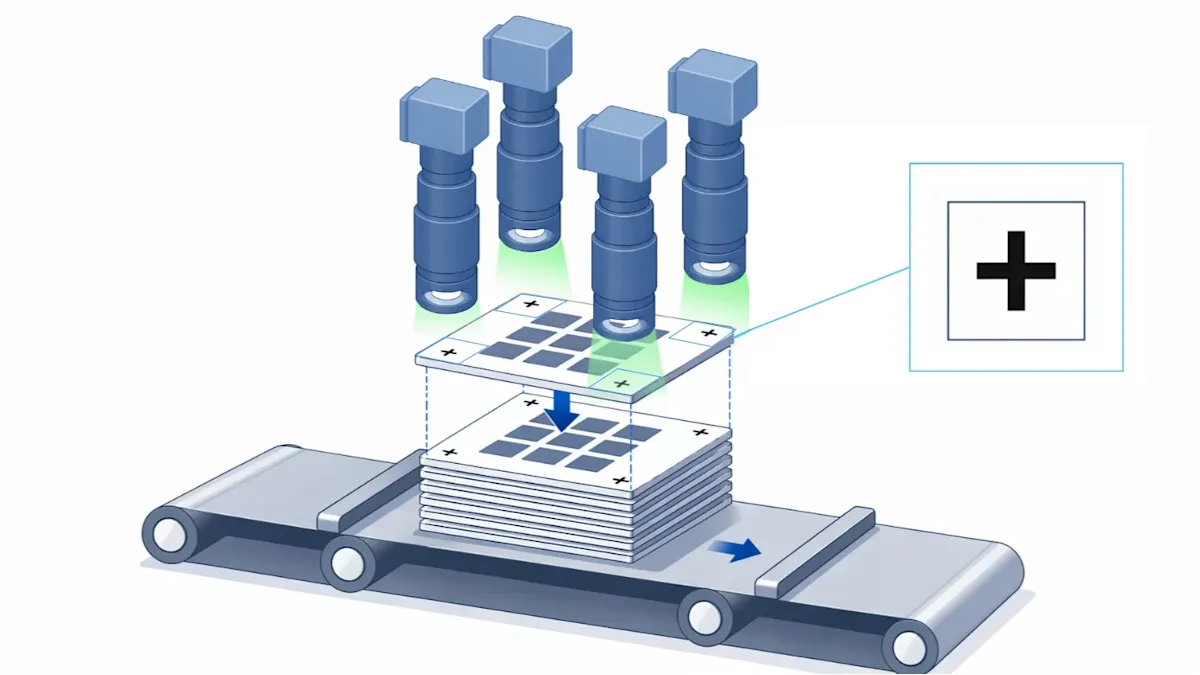
Optical requirements for automotive MLCC stacking inspection
Automotive MLCC stacking requires imaging with minimal distortion and stable dynamic focusing to ensure reliable alignment as stack height increases.
Misalignment at the micron level can lead to uneven internal stress during thermal expansion, reducing safety margins between electrodes and edges and increasing the risk of cracks or short circuits. To ensure long-term reliability, the inspection system must maintain stable imaging and accurate alignment detection across varying stack heights.
To address these requirements, two optical capabilities are essential: distortion-free imaging and dynamic focus control.
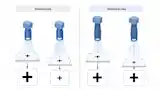
Dimensional accuracy under tight tolerances
Automotive MLCCs require tight external tolerances and consistent internal alignment to ensure safe operation under thermal expansion.
Standard lenses introduce perspective distortion as object height changes. As a result, alignment marks appear at different magnifications across layers, shifting edge positions and introducing bias in calculated center coordinates (ΔX, ΔY). These small alignment errors accumulate over successive layers, degrading overall stacking accuracy.
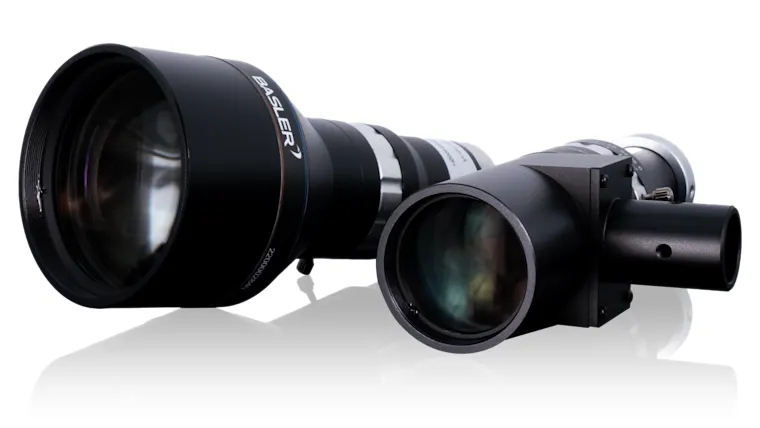
Telecentric lenses eliminate perspective distortion, ensuring consistent and accurate measurement across the stack height. When combined with dynamic focusing elements such as a liquid lens, slight magnification variation can occur due to changes in optical power. In practice, the resulting variation is typically small and predictable, allowing it to be managed through appropriate lens selection and system-level validation.
Stable focus across high layer counts
As the stack builds up, the focal plane continuously shifts beyond the limited depth of field.
Without dynamic focus adjustment, alignment marks at different heights cannot be kept consistently in focus, leading to variations in edge clarity and reduced stability in center detection.
Mechanical refocusing methods introduce additional challenges, including vibration, settling time, and limited response speed, which can negatively impact alignment precision and overall cycle time.
Liquid lens autofocus enables fast, non-mechanical focus adjustment to maintain image sharpness in real time, ensuring stable alignment reference across layers while supporting high-speed stacking processes.
Integrated liquid lens autofocus solution for MLCC stacking alignment
To meet these requirements, autofocus must operate as part of the vision system—not as an external add-on.

Selecting the right optics combination is the first step. In MLCC stacking applications with significant height variation, engineers must balance telecentric imaging stability with dynamic focus adjustment. Basler supports customers in selecting the optimal telecentric and liquid lens pairing for reliable alignment performance across the required focus range.
Integrating lens control to reduce cabling and integration complexity. Conventional setups drive the liquid lens from an industrial PC, adding cabling complexity and placing lens control responsibility on the system engineer. Our imaging solution integrates liquid lens control directly, simplifying the overall system architecture.
Preloading autofocus algorithms for a closed-loop, real-time focused image output. Autofocus algorithms run directly on the FPGA inside the imaging module. Focus adjustment operates in a closed loop tightly coupled with image acquisition, delivering a consistently sharp alignment mark image at every inspection cycle, without latency or mechanical settling delay.
Reliable alignment from layer one to one thousand
Stable focus across full stack height: consistent image sharpness maintained as layer height increases, with no mechanical movement or vibration-induced error.
Reliable alignment detection: consistent imaging supports accurate alignment with deterministic, acquisition-synced focus response.
Higher throughput: mechanical settling delays eliminated for faster stacking cycles.
Simplified integration: no external lens controller required, fewer components, reduced system complexity.
In automotive MLCC stacking, ceramic sheets used for stacking are physically thicker, and layer counts are increasing from several hundred up to around 1,000 layers to achieve higher capacitance in very small footprints such as 0603 or even 0402. As layer counts increase, maintaining sufficient depth of field with conventional optics becomes increasingly challenging, making liquid lens autofocus essential for stable focus during stacking.
Ceramic sheet inspection before stacking
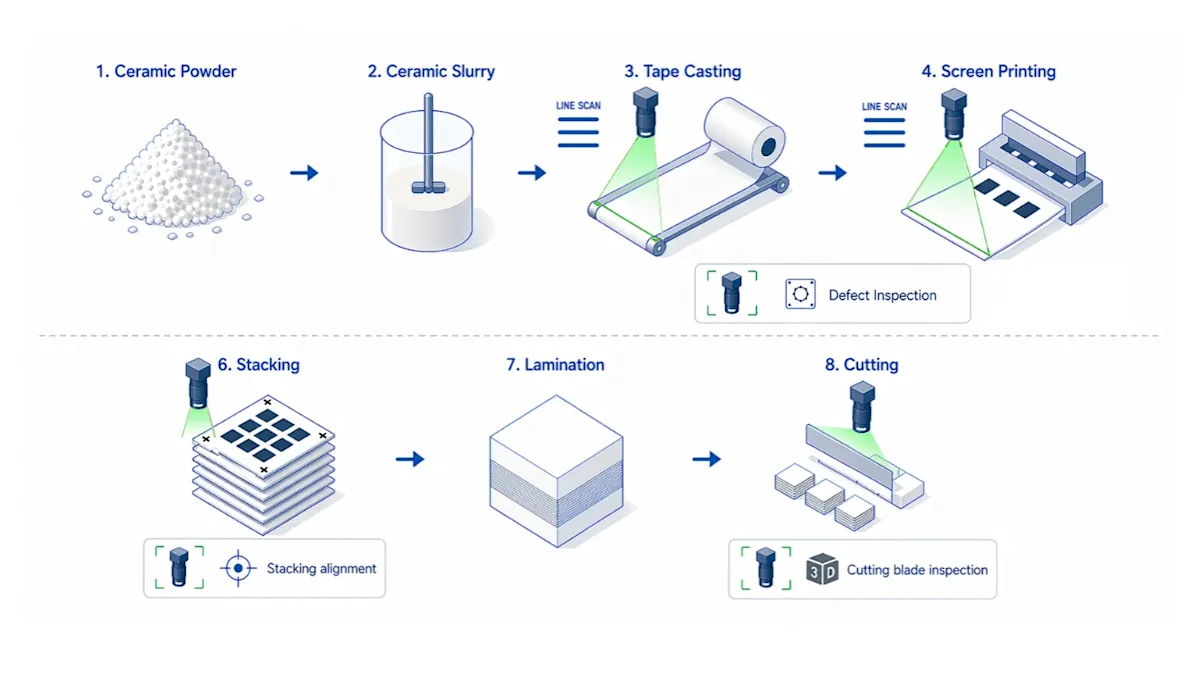
Before stacking, ceramic green sheets must be inspected for surface defects, contamination, or printing irregularities that can propagate into the final MLCC structure. These inspections are typically performed using high-speed line scan systems, enabling continuous imaging across large areas with consistent resolution and stable image quality across the full width.
Explore line scan cameras for high speed ceramic sheet inspections