Production-Ready OCR and OCV for Semicon and PCB AOI
What comes before AI
In semiconductor and PCB production, OCR failures are rarely caused by recognition algorithms. They are driven by instability in imaging conditions—something lab environments rarely replicate.

OCR failures in production are rarely caused by AI
OCR works well in controlled environments but often fails in production because factory conditions introduce vibration, speed variation, glare, and inconsistent marking quality—factors rarely reproduced in lab testing. Low-contrast laser etches shift with angle, while ink markings smear or fade over time, and without stable inputs, OCR accuracy collapses.
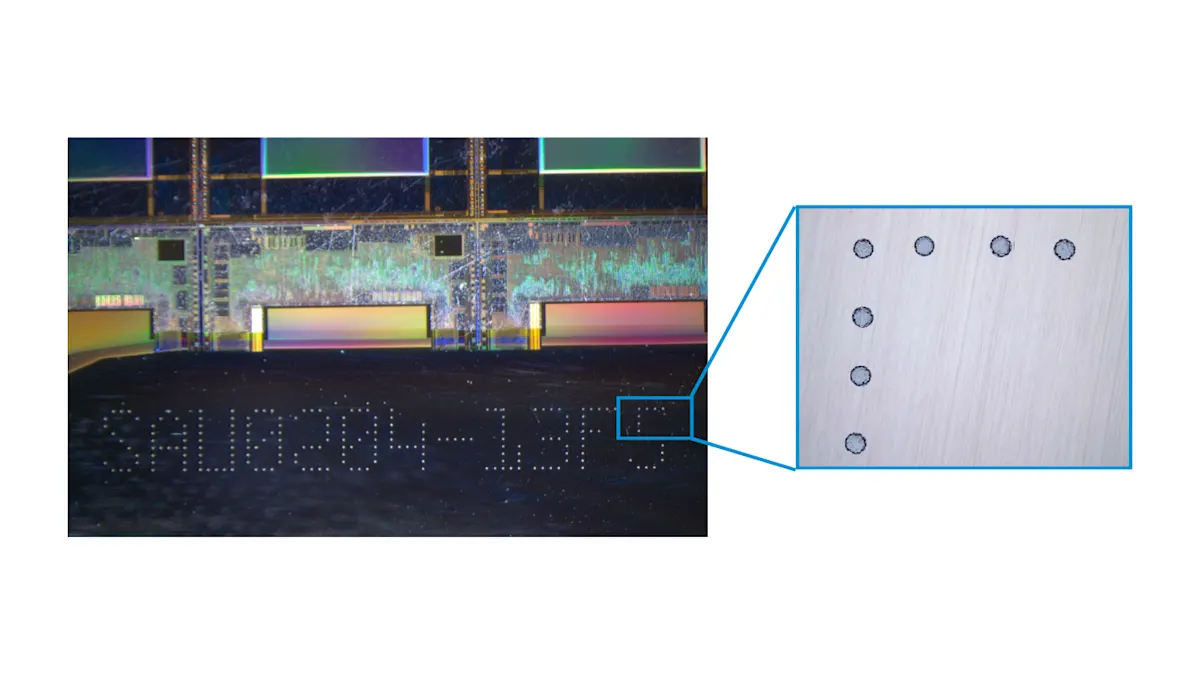
Why capture quality matters more than algorithms
In production, capture quality often outweighs algorithm choice, and even small improvements upstream can have outsized impact. For example, a backend line upgrade that improved fixturing rigidity and exposure timing delivered a significant reduction in false rejects without any model changes, reinforcing a well-established principle: stable, high-contrast images are the single biggest driver of OCR accuracy.
This is why OCR failures are rarely an AI problem. They are system-level issues. Weak front-end design, such as unstable optics or poor exposure control, feeds AI unusable data, which explains why AI upgrades often succeed in demos but fail at scale. In practice, reliable OCR starts with stabilizing the imaging pipeline, not the model.
OCR vs OCV: similar inputs, very different sensitivity
Optical Character Recognition (OCR) reads text, extracting strings like LM358 from images, while Optical Character Verification (OCV) goes further by assessing print quality and identifying issues such as smears, fades, missing segments, or misalignments. Although both rely on the same image input, their tolerance to variation differs significantly.
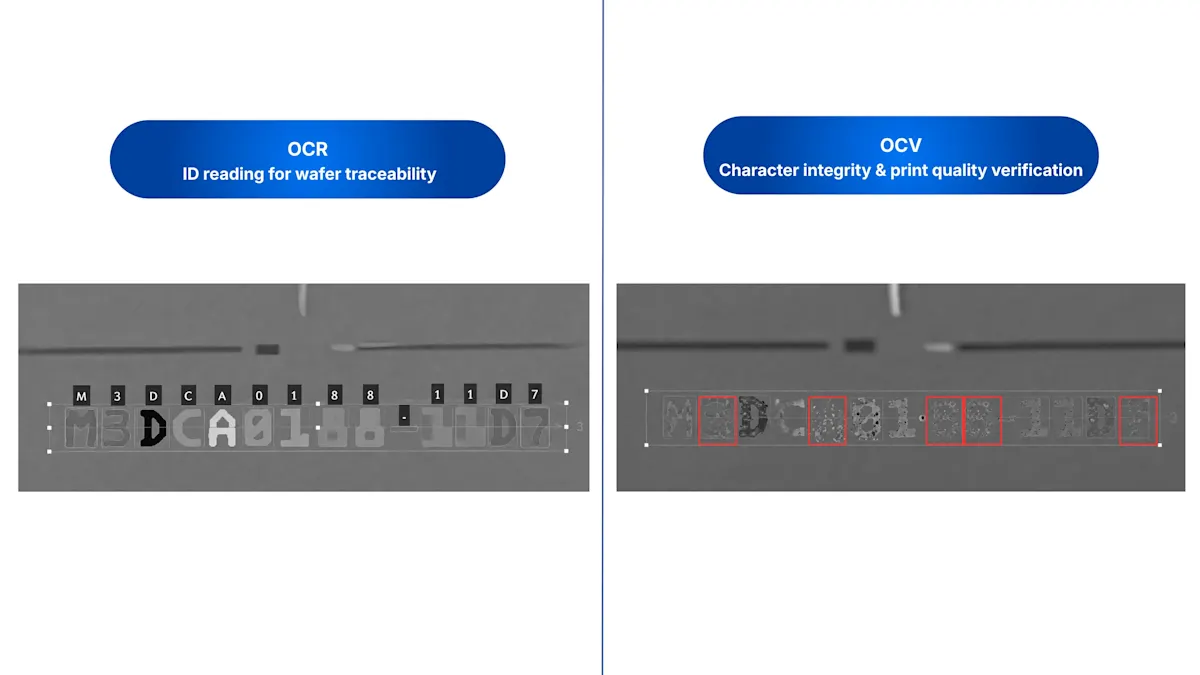
OCR vs OCV: key differences
OCR can tolerate moderate contrast variation or partial degradation as long as characters remain classifiable, but OCV evaluates finer details such as edge continuity, stroke width, contrast uniformity, and geometric completeness. As a result, OCV is far more sensitive to imaging instability, meaning that small variations in lighting, focus, or motion can quickly translate into measurable defects or false rejects.
OCR (reading) | OCV (verification) | |
|---|---|---|
Purpose | Extract text. | Verify print quality |
Tolerance | Moderate | Low |
Sensitivity | Lower | High |
System demand | Moderate | High |
Risk | May pass degraded text | May increase false rejects |
Stabilize your imaging pipeline before scaling OCR and OCV
Work with us to evaluate lighting, optics, and system design factors that directly impact recognition reliability.
Contact us to discuss your OCR/OCV imaging setupContinue with the practical OCR/OCV design guide
See what drives reliable OCR/OCV in production—from lighting, contrast, and synchronization to practical validation for semiconductor and PCB inspection.