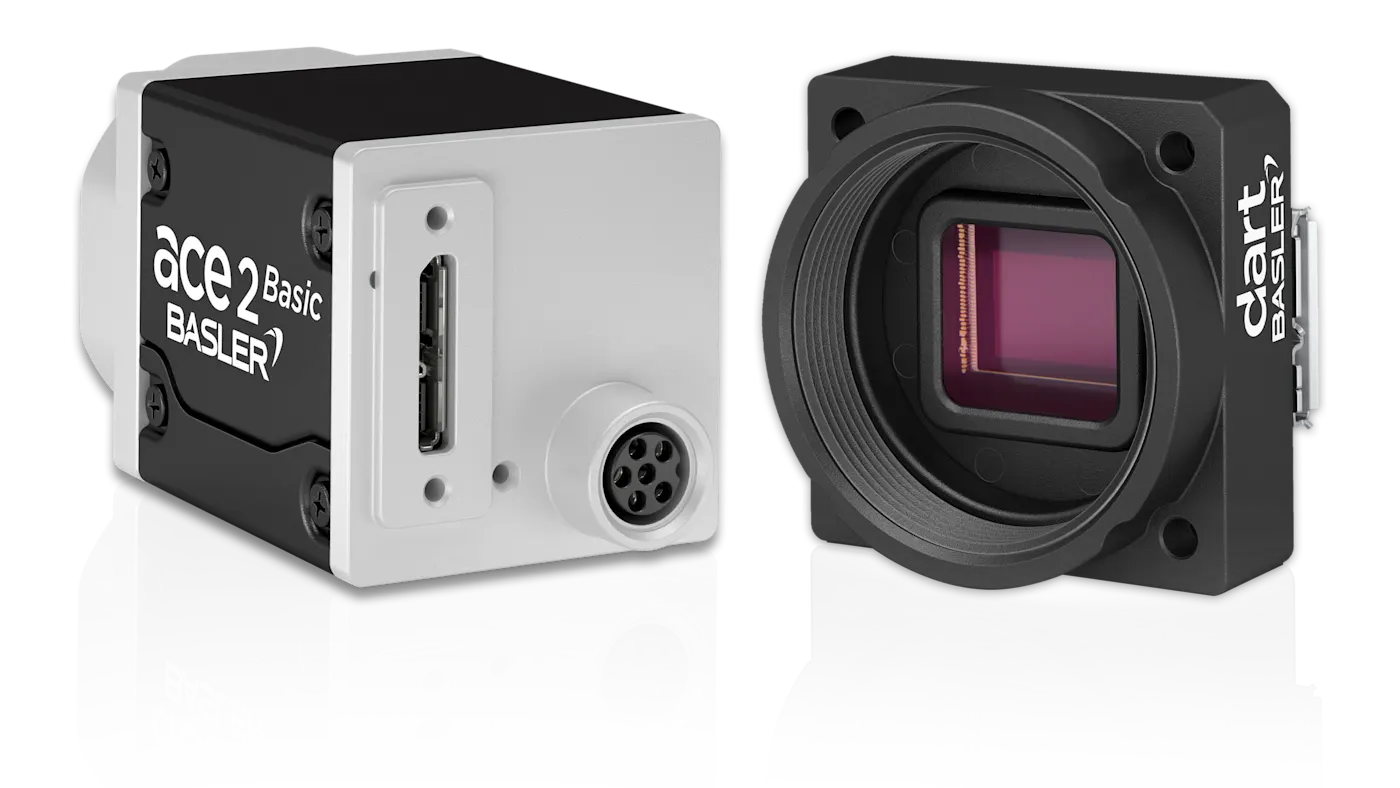
USB 3.0 Cameras
USB 3.0 is the newest interface on the image processing market. Read here about when USB 3.0 is the ideal choice for your applications, factors to remember during installation and which camera models Basler is offering you.
Our USB 3.0 camera models
The USB3 Vision standard

Discover the advantages of the USB 3.0 interface for your imaging applications:
High transfer rates: Benefit from bandwidths up to 350 MB/s for fast and efficient data transfer.
Real-time capability: Experience excellent real-time performance and stability in your applications.
Easy integration: Take advantage of easy integration into various imaging applications thanks to the USB3 Vision standard.
Setting up a stable USB 3.0 camera system
Questions that we answer in detail in our White Paper:
Why should I switch to USB 3.0?
How do I set up a stable USB 3.0 camera system?
How do I set up a multi-camera system with USB 3.0 cameras?
Find the right interface for your application
The Basler Interface Advisor helps you to decide which interface is most suitable for your project.
 GigE
GigE 5 GigE
 USB 3.0
 CXP-12CoF
 BCON for MIPI
 Camera Link
Further options
Basler USB 3.0 cameras
The following camera series are available with the USB 3.0 interface:


Prerequisite for successful market establishment
The aim of the standard is to create a uniform regulation of USB 3.0 communication and structure. Without such a standard, there would be countless different accessory components and individual solutions from the individual manufacturers - the range would be opaque for the end customer and difficult to overview.
Before the publication of the USB3 Vision Standard, there was no regulation of USB devices in the image processing industry. Individual solutions from the various manufacturers existed, creating a range that was difficult for the end customer to understand. While this was sufficient in most cases, there was no guarantee of product stability, long-term availability of components, or overall system robustness. History has shown that the logical implementation of an interface and a corresponding standard are crucial for a technology to become successfully established and spread in the machine vision market.