Dynamic Obstacle Detection for AMRs in Warehouse Logistics
Reliable navigation and stable material flows through camera-based 3D perception
3D stereo cameras capture the environment around autonomous mobile robots (AMRs) in three dimensions, delivering real-time depth data for navigation and local obstacle avoidance. Combined with downstream perception and navigation software, obstacles and changes in the planned path can be detected early. This supports efficient material flow and reduces the risk of collisions and unplanned stops.
3D image data for navigation and obstacle avoidance
Early and reliable obstacle detection is essential for the efficient operation of AMRs in warehouse environments. 3D stereo cameras complement other sensors by providing spatial information about the robots' surroundings. Based on this depth data, the navigation software takes into account, for example, protruding objects in narrow aisles or vehicles at intersections and adapts the planned path accordingly. This reduces the risk of collisions, incorrect routing decisions, and damage to the load. Moving objects, such as people, can also be detected based on their 3D geometry. However, safety-related personal protection must be ensured independently of this through appropriate, certified safety technology.
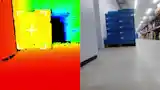
Obstacle detection in narrow aisles
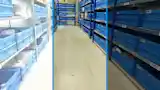
The camera captures a 3D view of the area in front of the vehicle. The depth data it generates helps the perception and navigation software detect nearby obstacles and consider them during local path planning.
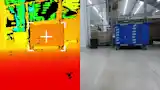
Obstacle detection at aisle intersections
3D data also makes protruding forks, pallet edges, or vehicle corners visible in three dimensions. This allows the perception software to detect such obstacles early on and provide this information to the navigation system.
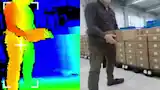
Capture of moving objects
Stereo vision captures the 3D shape of moving objects even when their position or the person's posture changes. Reliable person classification and safety-oriented personal protection require additional software or certified safety sensors.
3D stereo vision complements existing navigation sensors, particularly in situations where overhanging obstacles or complex spatial structures need to be detected. The key is the interplay between an appropriate camera position, robust perception software, and separately designed safety technology.

Stereo mini camera for AMRs and obstacle detection in warehouse logistics
Precise 3D measurement even in tight spaces: the Basler Stereo mini camera is ideal for short working distances and limited space—whether in compact machines, mounted on a robot arm, or in other space-constrained environments.
ToF cameras for longer working distances and larger perception ranges
For large autonomous industrial trucks such as autonomous forklifts, longer working distances and wide perception ranges may be required, such as in wide aisles, in front of racks, or when loading trucks. For such applications, a ToF camera can be a suitable alternative to a stereo camera. However, the choice of 3D technology depends on the specific requirements, particularly working distance, accuracy, ambient light, surface properties, and integration complexity.
Learn more about the Basler ToF CameraBasler Stereo mini: Compact 3D camera for navigation and obstacle detection
The Stereo mini provides depth images and 3D point clouds for environmental perception of autonomous mobile robots. Based on this data, the downstream perception and navigation software can consider obstacles, distances, and changes in floor level. Due to its compact design and various interfaces, the camera is particularly well-suited for AMR platforms with limited installation space and for embedded systems. The achievable measurement quality depends on the working distance, mounting position, lighting, and the surfaces of the objects being captured.
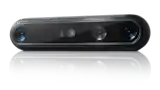
Basler Stereo mini 951g: Compact and lightweight
The Basler Stereo mini 951g is particularly well-suited for compact AMR platforms with limited installation space. It provides depth data with low latency and covers a working range from 0.25 m to 6 m. The GigE interface supports robust integration into mobile robot systems.
Compact size: 124 mm × 29 mm × 50 mm
Lightweight: 220 g
Designed for use in industrial warehouse environments
The Basler Stereo mini 951g features a rugged housing with IP67 protection, making it best suited for dusty and humid environments.
Automatic exposure control makes it easier to operate in changing lighting conditions. In dark or low-texture scenes, the built-in pattern projector can project an additional texture onto surfaces, improving depth calculation. The achievable measurement quality depends on lighting, surface texture, and working distance.
Integration into mobile robot systems
The Basler Stereo mini 951g combines a compact design with a robust GigE interface. This makes it ideal for distributed system architectures and longer cable runs within the vehicle.
95 mm baseline for close- and mid-range distances
Working range from 0.25 m to 6 m
GigE interface for flexible integration into AMR systems
2D and 3D image data for localization and environmental perception
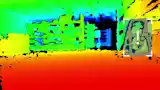
The Stereo mini provides 2D images, depth data, and 3D point clouds of the vehicle's environment. Depending on the system architecture, this data can be used for visual localization and mapping as well as for local obstacle detection.
When combined with other sensors such as LiDAR and IMU, the stereo camera can supplement environmental perception. It provides spatial information beyond individual LiDAR scan planes, supporting the detection of obstacles, overhanging objects, and elevation changes. The analysis of sensor data, path planning, and the vehicle’s reaction are handled by the downstream navigation and perception software.
Why milliseconds matter: Latency in dynamic AMR applications
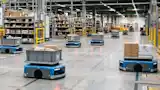
For obstacle detection and local navigation, depth data must be as up-to-date as possible. The end-to-end latency of the entire processing chain—from image acquisition and depth calculation through data transmission and analysis to the vehicle’s reaction—is decisive.
At a travel speed of 1.5 m/s, a 100-millisecond delay already corresponds to a distance traveled of 15 cm, in addition to the required braking distance. Low and stable latency supports rapid reactions to newly detected obstacles and must be taken into account when designing navigation and braking behavior.

Integration via the pylon SDK
The Basler Stereo mini 951g is integrated into the pylon SDK. 2D images and depth data can be acquired and configured using a single software environment. The pylon Viewer supports commissioning and verification of camera settings.
Programming interfaces for C++, C#, and Python enable the camera to be integrated into the AMR's perception and navigation software—from evaluation through to production deployment.

Support with selection and integration
Basler supports AMR manufacturers in selecting, evaluating, and integrating the right 3D camera. Our FAE team assists with evaluation and commissioning. The pylon SDK provides a unified software environment for configuring and accessing 2D and 3D data.
Assistance with selecting the camera
Technical support for evaluation and integration
Uniform software integration via the pylon SDK