Centroid Calculation for High-Precision Drilling
Precision and process reliability reduce scrap
To ensure the precise positioning of vias, PCB manufacturers rely on machine vision and advanced image processing algorithms. The nominal positions are compared with the corresponding positions in the PCB layout data, but reflections and variations in the PCB surface and material properties make it difficult to detect edges reliably. We demonstrate how our tailored image analysis algorithm can be used to achieve reliable and precise center point determination.
Machines for printed circuit board (PCB) manufacturing
Complex system landscapes that have evolved over time
PCB manufacturing is characterized by high demands of process stability, traceability, and reproducible quality characteristics. At the same time, in practice, the industry is dominated by long-serving existing equipment with established machine, control, and vision architectures. New image processing solutions must not only be functionally advanced but also capable of integrating with existing industrial software and control environments without disproportionate integration costs.
High-performance chips require the highest quality grade
Class 3 in IPC-A-600G defines the highest classification for PCB acceptability reliability, particularly concerning visual defect inspection criteria for features such as holes. It applies specifically to devices where failures can have severe consequences.
Precise via positioning through pilot-hole drilling
Pilot holes define the positions for subsequent via drilling. The vision system must measure their positions with high precision and repeatability. This ensures that the subsequent drilling can be positioned accurately and reliably.
Vision in challenging conditions
Drill chips, generated during pilot-hole drilling, make it difficult to identify measurement features.
Reflections, variable contrasts, and thermally or mechanically induced deformations on a PCB affect image quality and measurement accuracy.
Hybrid AI: AI-based preselection meets precise rule-based algorithm
The solution combines semantic, AI-based preselection with precise geometric analysis. This enables reliable detection and highly accurate measurement of pilot holes and reference features.
AI-based detection of pilot holes and reference features
Image analysis combines PCB layout data with AI-based object detection and localization. A transformer-based model identifies pilot holes and reference circles within defined search regions, using their semantic context within the image to reliably detect and localize up to 128 pilot holes.

Greater precision through the combination of AI and a rule-based algorithm
The localized circular features are measured with high precision using rule-based geometric image processing. The center and diameter of the pilot holes are determined deterministically and reproducibly from the captured image data and are available for further process evaluation—such as actual-to-nominal comparison or drilling-position correction.
Hybrid AI: What our engineers have to say
Our semantic approach makes circle detection robust in situations where traditional methods fail due to reflections, scratches, and broken edges—it can be adapted to the application without the need for customer-specific retraining.

The hybrid algorithm combines the generalization capabilities of modern vision-language models with the efficiency of an industrial image processing pipeline. This results in robust recognition results with minimal application-specific retraining, while also delivering the precision, speed, and reliability required by production applications.

Integration interface
What should you do if your existing software architecture does not allow you to switch to the high-performance Basler algorithm and the pylon software environment? The solution includes an integration interface to third-party libraries such as Aurora Imaging Library or MVTec HALCON.

Seamless integration of the Basler algorithm into a third-party library
If the given software architecture includes a third-party image processing library, the Basler &RD team will develop an interface that integrates the high-performance Basler algorithm into the third-party library. The additional image processing path for centroid and diameter calculation of the pilot holes can then be integrated without requiring changes to existing software architecture.
Learn more about Basler R&D development capabilitiesVision products for robust, reproducible inspection
Due to the challenging manufacturing conditions, this requires particularly high resolution, geometrically favorable optics, and homogeneous, contrast-enhancing illumination.
To ensure reliable via inspection on green PCBs, the machine vision products were specifically designed for maximum contrast and measurement accuracy.
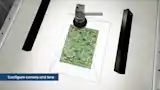
Monochrome, high-resolution Basler ace 2 camera
A monochrome ace 2 camera with 20.2 MP and a GigE interface captures even the smallest holes with high detail. Its high resolution supports precise edge detection, while the GigE interface ensures reliable and efficient image transmission to the evaluation computer.
Lens
The telecentric lens is designed for a working distance of approximately 110 mm and provides a telecentric image of the printed circuit board. This minimizes perspective distortion and enables precise edge detection across the entire field of view.
Red lighting
A red ring light creates high contrast between the drill holes and the green PCB surface. This allows drill hole edges to be reliably detected and ensures reproducible inspection results—even in the presence of drill chips, reflections, or thermally or mechanically induced deformations of the circuit board.
Solution for centroid calculation for high-precision drilling
With our solution, you get everything you need for precision drilling in PCB manufacturing and other industries: A high-resolution camera, the right lens, and advanced software development that includes a robust image-processing algorithm and integration interface.