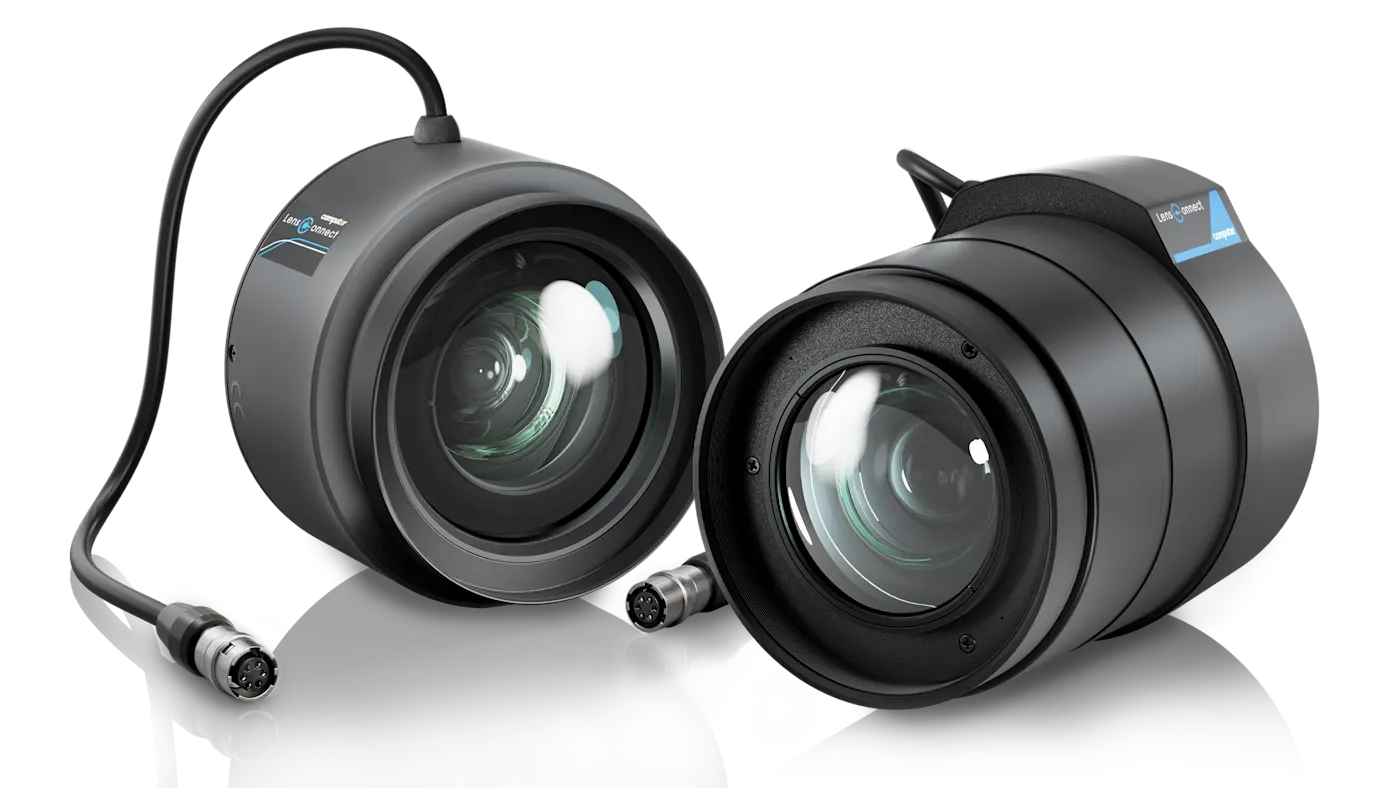
Motorized Lenses
Automated focus, zoom, and aperture adjustment
Motorized lenses allow for flexible and automated adjustment of focus, zoom, and aperture. All lenses in our portfolio are manufactured by Computar. They can be controlled directly through compatible Basler cameras using the same SDK, which simplifies integration and operation.
Automated settings
Automated focus, zoom, and aperture adjustmentFor various sensors
Suitable for sensor sizes up to 1.1" and resolutions up to 20 MPFixed or variable focal length
Lenses with a fixed focal length or a focal length rangeEasy control
Can be controlled directly through the Basler camera within the same SDK
Motorized lenses at a glance
Find the right lens for your application or learn more about the motorized lens manufacturer Computar.
What are motorized lenses?
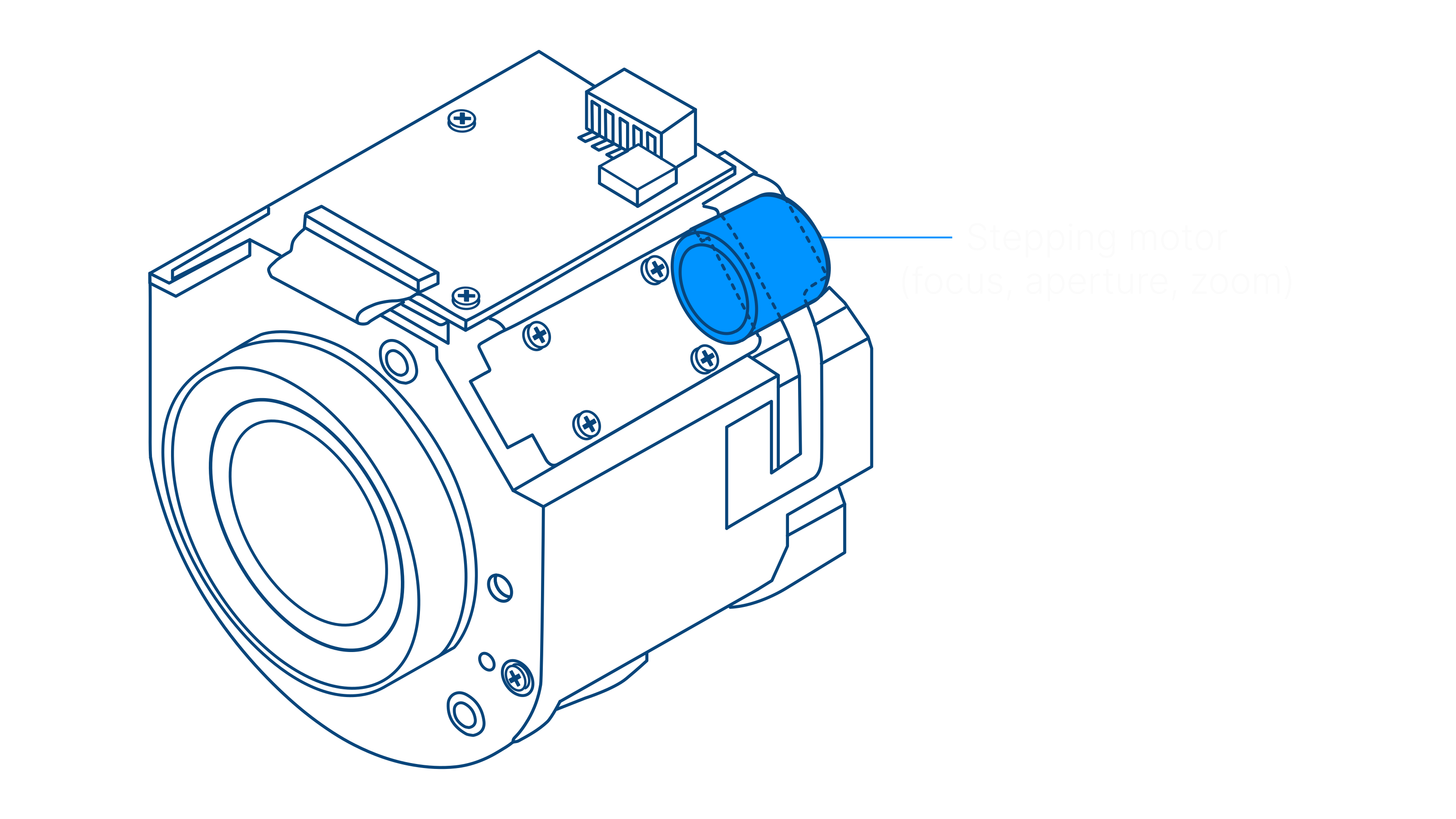
Motorized lenses, also known as motorized zoom lenses, enable automated control of focus, zoom, and aperture (iris). Built-in actuators, such as stepper motors, electronically adjust the optical parameters and can be controlled directly via image processing software.
Unlike traditional lenses, no adjustments to the lens are required. Settings can be automatically adapted to different production conditions, significantly increasing the flexibility and efficiency of machine vision systems.
Motorized lenses are suitable for applications involving changing object distances, varying product sizes, or automated inspection processes.
Advantages of motorized zoom lenses
High process flexibility
A single camera system can handle a variety of products, formats, and inspection scenarios. This reduces changeover times and downtime.
Autofocus
When working distances vary, the motorized focus control ensures consistently sharp images and reliable inspection results.
Low maintenance requirements
Since no manual readjustment is required, motorized lenses are suitable for hard-to-reach or enclosed systems.
Remote access and centralized control
Focus, zoom, and aperture settings can be adjusted directly through the software, even while the camera is in operation.
Future-proof automation
Integration into higher-level control and image-processing systems enables easy implementation of intelligent, highly automated processes.
A comparison: liquid lenses and classic lenses
Feature | Motorized Lenses | Classic Lenses |
|---|---|---|
Focus setting | Electronically controllable | Manual adjustment |
Zoom control | Can be automated | Manual adjustment |
Aperture setting | Electronically controllable | Manual adjustment |
Dynamic focus adjustment | Supported | Not possible |
Flexibility | Very high | Limited |
Maintenance costs | Minimal manual intervention | Regular readjustment is possible |
Capital expenditures | Higher | Low |
Conclusion: Motorized lenses are suitable when automated, precise, and flexible lens control is required. They offer high process dynamics while minimizing the need for manual intervention. Conventional lenses, on the other hand, remain a cost-effective solution for applications with fixed settings or when manual adjustment is sufficient.
Applications of motorized lenses
Motorized lenses are suitable for industrial applications involving varying object sizes, working distances, or fields of view. Electronic control of focus, zoom, and aperture allows for automatic adjustment of image capture. This improves process reliability, reduces the need for manual intervention, and increases productivity.
Barcode and OCR reading in logistics
Vision-guided robotics and pick-and-place applications
Automated optical inspection (AOI)
Traffic monitoring and intelligent transportation systems (ITS)
Semiconductor and electronics inspection
Packaging and production lines
Quality control in industrial manufacturing