Quantum Efficiency and Its Relevance for Machine Vision
Quantum efficiency (QE) is a key parameter for precise, reliable, and efficient machine vision solutions. It describes how effectively an image sensor converts incoming photons into electrons and, consequently, into a usable signal. A high QE can increase the useful signal under identical lighting and exposure conditions, and thereby influence image quality, exposure time, lighting power, and system costs. In this article, we show how QE's influence is defined across a variety of application requirements.
Last updated: 10/11/2026
Reading time: approx. 9 Minutes
Key facts about quantum efficiency
QE describes how efficiently an image sensor converts incoming photons into electrical charge
Well suited for high-speed, low-light, and NIR applications
High QE enables shorter exposure times, lower lighting power, or less gain
High QE improves signal yield and can thus contribute to higher-quality imaging
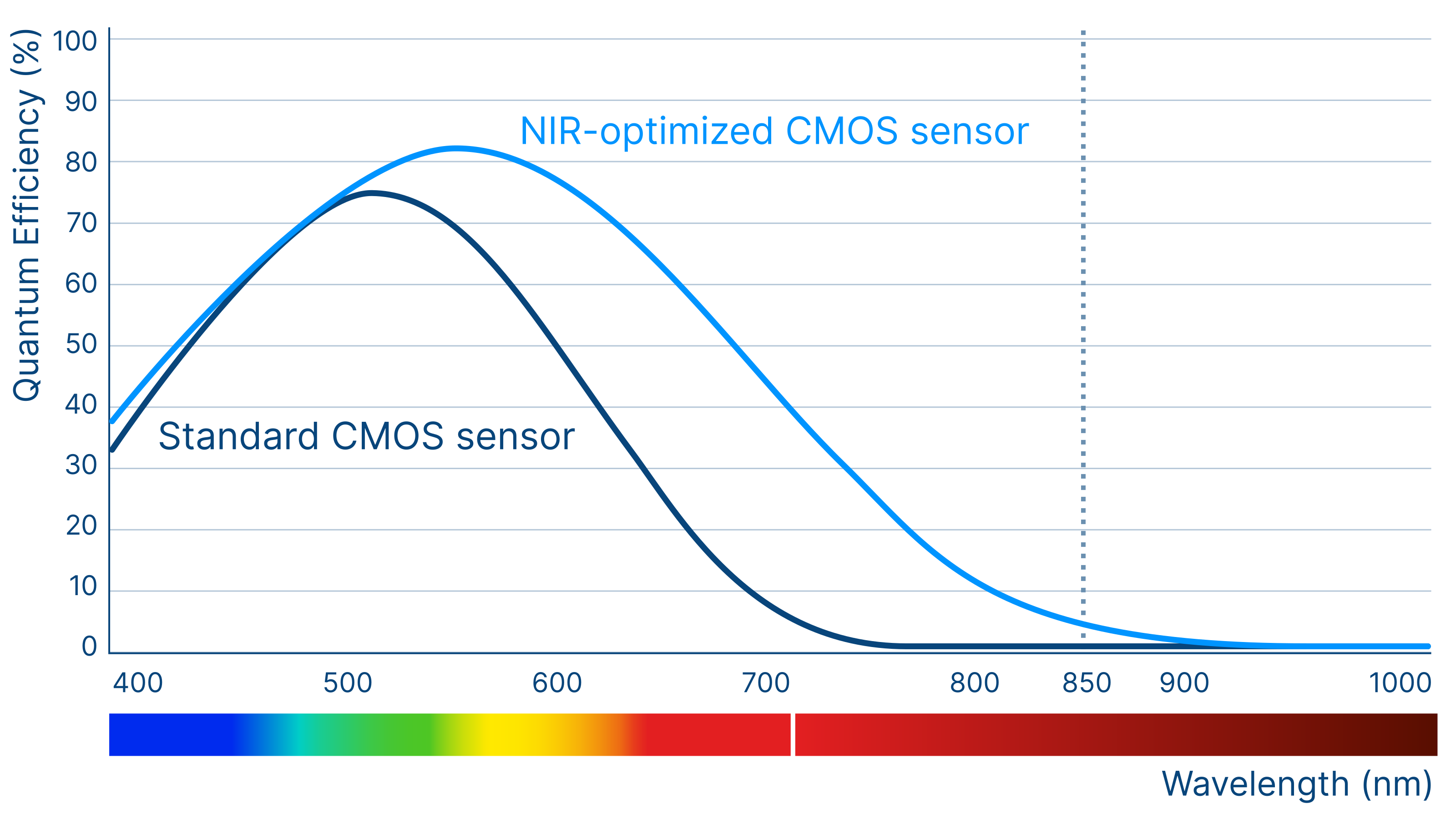
QE values depend on the wavelength and differ significantly between visible light and NIR in CMOS sensors
The significance of quantum efficiency for your machine vision application
Quantum efficiency is not an abstract metric; in practice, it dictates whether your application works reliably or fails at the limits of what is physically possible. But which QE values are actually necessary for specific requirements? There is no universal minimum QE. What matters is the QE value at the illumination wavelength being used and whether it enables the required signal-to-noise ratio alongside pixel size, exposure time, and noise.
So when does the premium for highly specialized sensors pay off? In the following sections, we present typical requirement profiles from machine vision practice.


What parameters strongly influence quantum efficiency
Quantum efficiency is defined as the ratio of generated signal electrons to the number of incident photons and is one of an image sensor's key characteristics. The higher the QE, the more usable signal the sensor produces for the same amount of light. In image acquisition and subsequent image processing, quantum efficiency directly or indirectly influences several essential parameters.
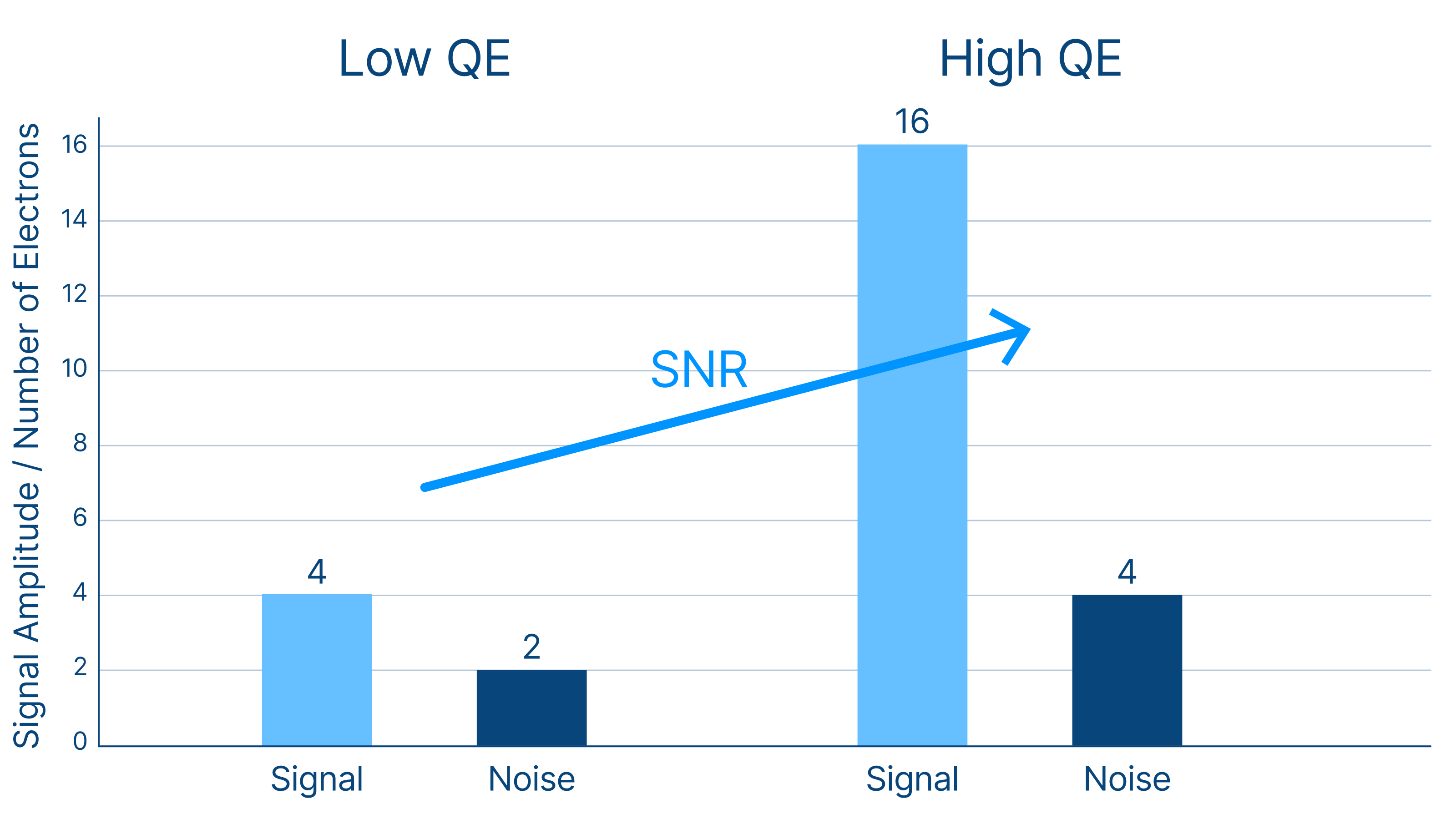
Signal-to-noise ratio (SNR)
A higher QE converts more photons into electrons for the same amount of light. This increases the useful signal, which directly improves the signal-to-noise ratio. Since photon noise increases only with the square root of the number of electrons, the signal-to-noise ratio improves even in light-limited applications.
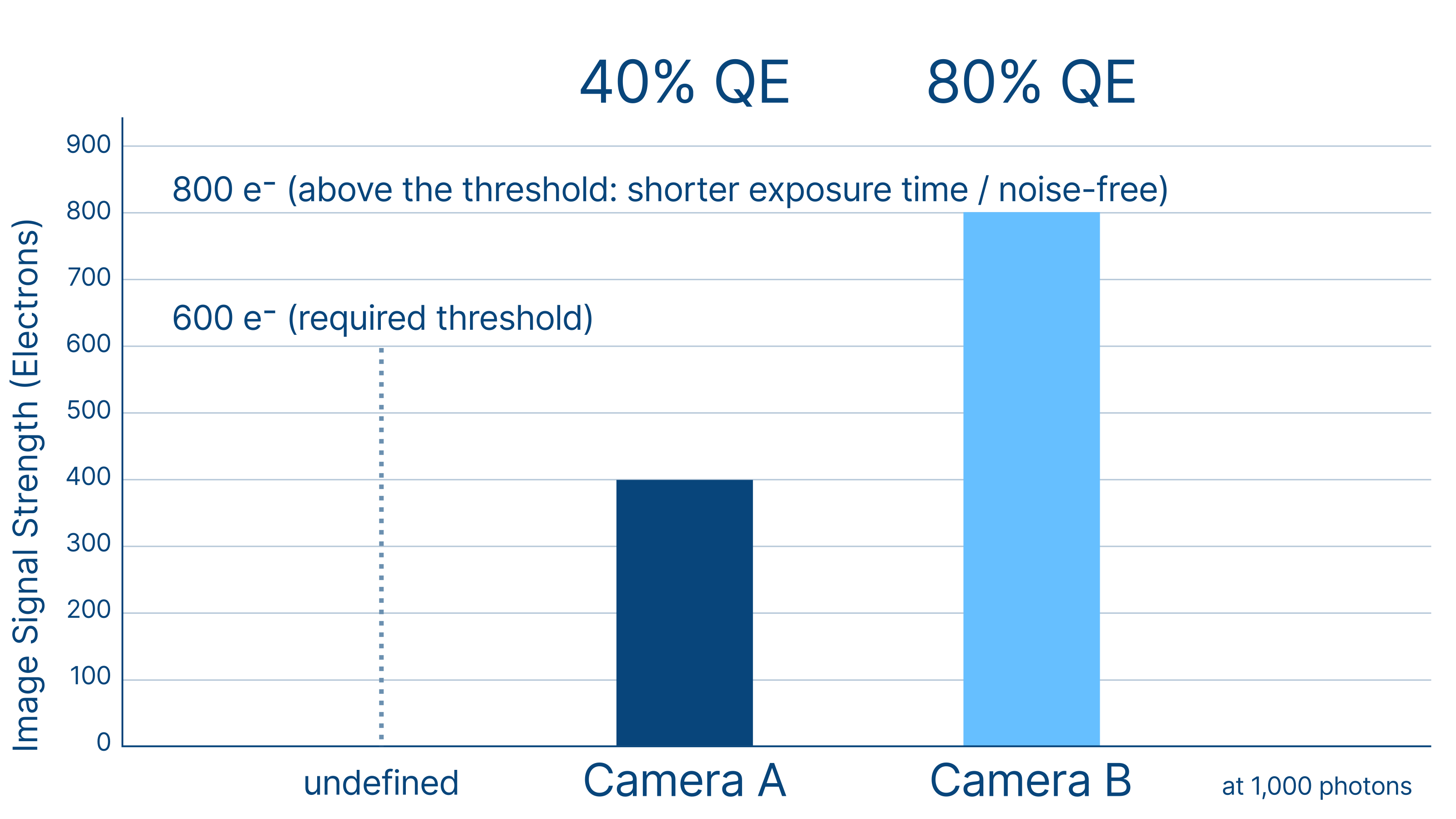
Minimum lighting & sensitivity
QE describes how many photons are converted into electrons: at 80% QE, 1,000 photons produce approximately 800 electrons; at 40%, only 400. A higher QE enables imaging at lower light levels. This allows cameras to capture a sufficiently strong image signal even at short exposure times, without having to significantly amplify the signal.
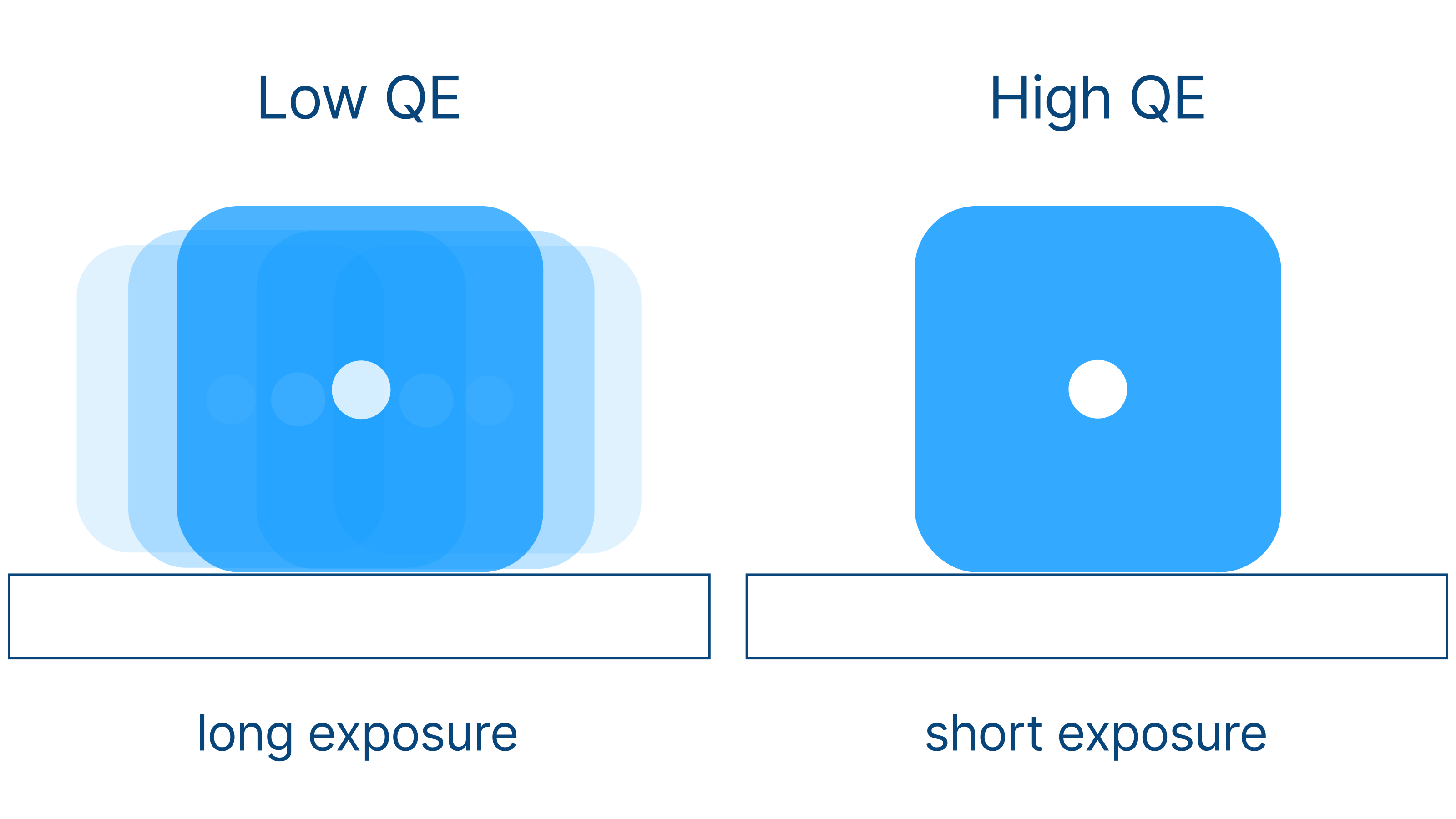
Exposure time & maximum frame rate
Since higher QE builds up sufficient signal in less time, exposure time can be reduced without introducing noise into the image. This allows for:
Higher frame rates (fps)
Avoiding motion blur
Important factors influencing QE
Parameter | Influence of quantum efficiency | Practical result of high QE |
SNR (signal-to-noise ratio) | Proportional to QE | Sharper, noise-free images in low light |
|---|---|---|
Exposure time | Inversely proportional | Less exposure time needed, higher frame rates |
Signal gain
| Inversely proportional
| Lower digital gain, less image noise
|
Spectral sensitivity | Wavelength-dependent | Optimized capture of specific wavelengths, e.g., in the NIR or UV range |
Sensor architecture and QE optimization
Sensor architecture and QE optimization significantly influence how efficiently an image sensor converts incoming light into electrical charge. Frontside and backside illumination, a spectrally optimized sensor design, and pixel size together determine light yield and, consequently, image quality. The key is to design these factors to match the specific application and the relevant wavelength range.
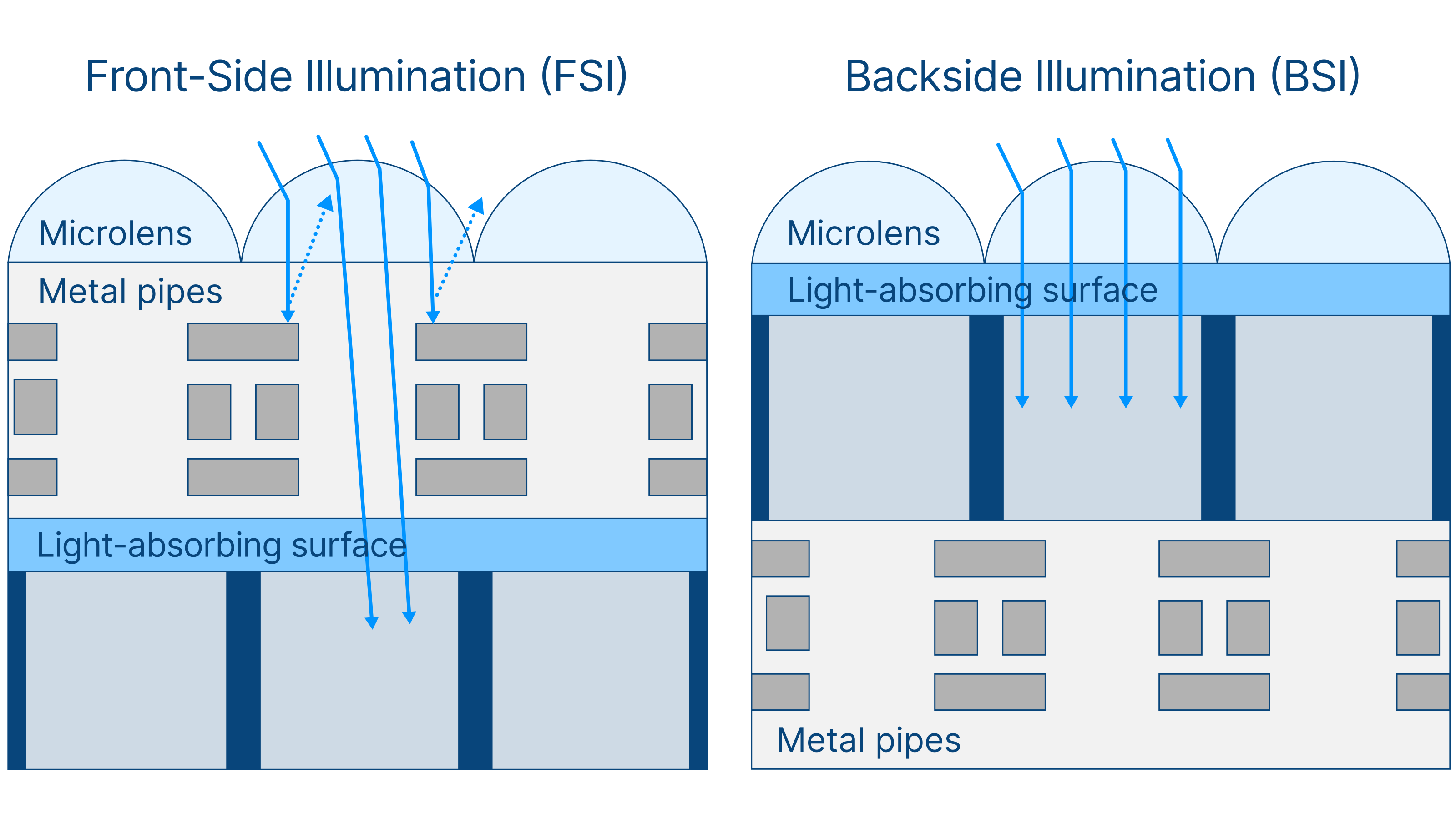
Frontside vs. Backside Illumination
In frontside-illuminated (FSI) sensors, the readout electronics are located on the light-facing side, reducing the sensitive area. Microlenses focus the light onto the sensitive regions, improving light yield. Backside-illuminated (BSI) sensors are exposed from the rear, so light reaches the photosensitive layer directly. This is particularly advantageous with small pixels and low light, enabling higher QE.
Spectral optimization
QE is wavelength-dependent. A standard CMOS sensor can be sensitive in visible light, but QE drops dramatically in the infrared range. However, there are also CMOS sensors whose pixel design enables improved QE in the NIR range. For applications in the NIR range, the sensor should match the wavelength of the light source used.
Pixel size and fill factor
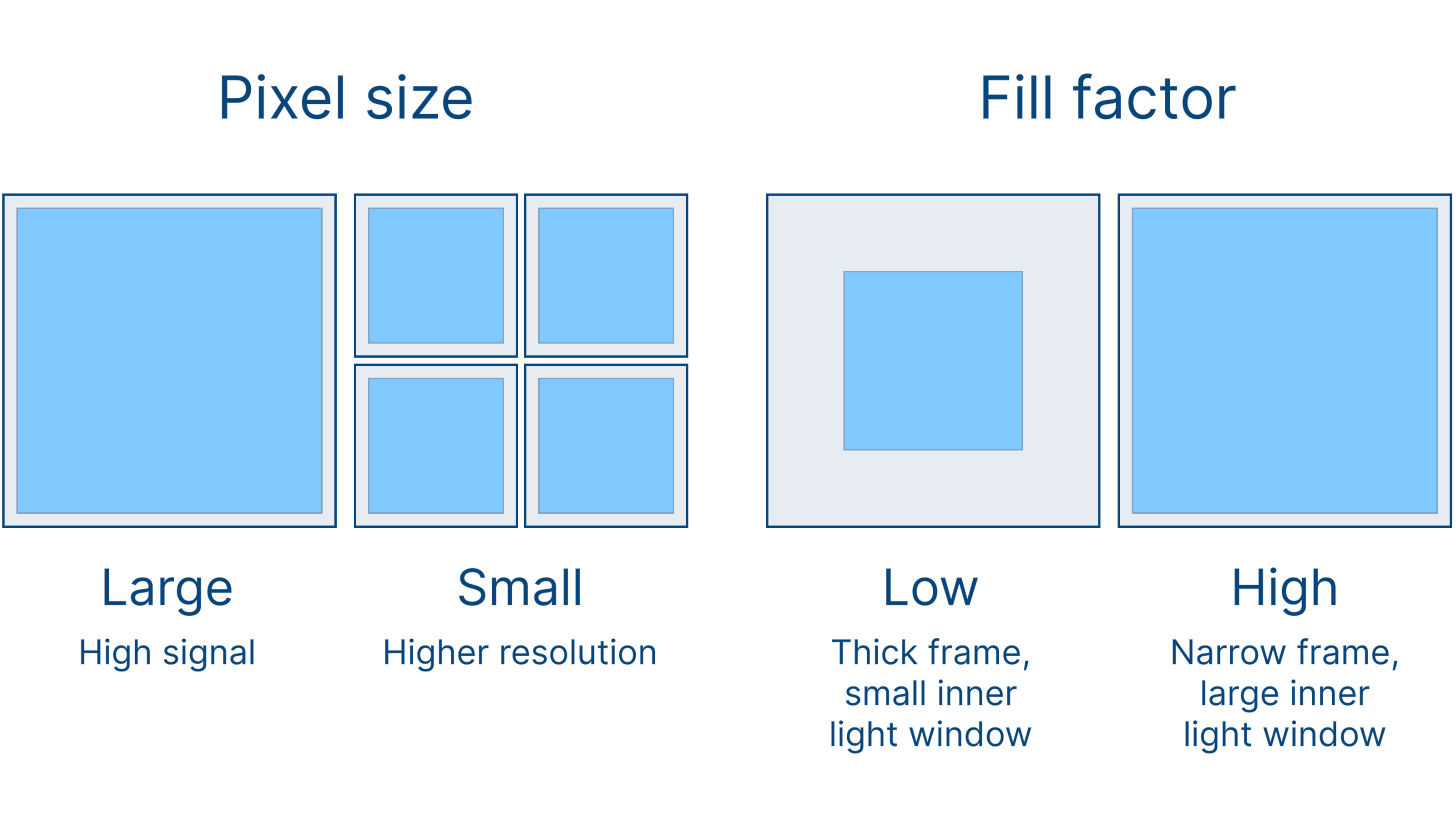
Larger pixels collect more photons than smaller pixels at the same exposure time and QE, increasing the signal and improving SNR. Smaller pixels, on the other hand, allow for higher spatial resolution and more compact systems. The fill factor describes the proportion of the pixel surface that is actually light-sensitive. A high fill factor improves photon yield and supports a high QE.

QE measurements according to EMVA standard
The EMVA 1288 standard defines uniform procedures for measuring and presenting the image quality of cameras and image sensors. Key parameters such as quantum efficiency, dark noise, saturation capacity, signal-to-noise ratio, and dynamic range are made transparent and comparable as a result.
To the EMVA standardQE: A critical factor in image quality and sensor selection
Quantum efficiency is a key metric for a camera's light sensitivity. It determines how efficiently a sensor converts photons into electrons, and thus influences signal strength, signal-to-noise ratio, and detail detection. Depending on the spectral range and application, different requirements apply — from the visible range to specialized NIR or SWIR sensitivity. Considering quantum efficiency alongside other sensor data allows for more precise camera selection for demanding image processing tasks.
FAQs about quantum efficiency
Quantum efficiency describes how efficiently an image sensor converts incoming photons into electrical signal electrons. A QE of 80%, for example, means that out of 1,000 incoming photons, approximately 800 electrons are generated. The higher the QE at the same amount of light, the stronger the usable image signal.
A high QE is particularly relevant for short exposure times, high frame rates, low-light conditions, and NIR applications. It allows a sufficiently strong signal to be generated in less time, avoiding motion blur, additional gain, and higher light output.
At the same pixel size and exposure time, a sensor with higher QE delivers a stronger signal and has a positive effect on the SNR. However, the SNR is also influenced by noise and pixel size. For a low-noise sensor with a large pixel, SNR can be better despite lower QE than a noisier sensor with smaller pixels and significantly higher QE. For a well-founded evaluation, standardized measurement data — for example, according to EMVA 1288 — should also be consulted.
No. QE depends on the wavelength and can differ significantly between visible light and NIR. For selection, the QE curve in the relevant spectral range, the pixel size, and the sensor noise, as well as the lighting, object, filter, protective glass, and lens, must all be considered together. Only the interplay of these factors determines the achievable image quality and the signal-to-noise ratio.
Quantum efficiency (QE) is determined by, among other factors, sensor architecture, fill factor, and microlenses. Backside-illuminated sensors can offer advantages, particularly with small pixels, since the light is less shielded by metal layers and transistor structures. For a well-founded evaluation, standardized measurement data — for example, according to EMVA 1288 — should also be consulted.
Which sensors are suitable for the visible range?
For approximately 400–700 nm, monochrome CMOS sensors with high QE are well suited. They deliver detailed images and high signal quality. Color sensors with matched spectral sensitivity enable reliable color detection — for example, in surface inspection, print inspection, or assembly monitoring.
What matters in the NIR range?
In the near-infrared range of approximately 700–1,000 nm, the QE of conventional CMOS sensors often decreases. NIR-optimized monochrome CMOS sensors deliver a higher signal at the same photon density and make features visible that are difficult to detect in visible light — for example, in food inspection.
What are the benefits of high QE in the SWIR range?
In the SWIR range of approximately 1,000–2,500 nm, high QE improves signal acquisition. This is relevant for semiconductor inspection, pharmaceutical quality control, moisture measurement, and foreign object detection. The usable spectral range depends on the sensor type. In addition, high QE can reduce the required illumination power.