Key facts about optimizing computing performance for AI vision systems
Maximum performance: Preprocessing on frame grabbers / FPGAs reduces latency and enables stable frame rates even at high resolutions and multi-camera setups.
Relieving CPU and GPU: Offloading typical tasks to the frame grabber frees up resources for complex AI algorithms.
Long-term cost savings: Reduced need for high-end hardware, lower maintenance requirements, and better scalability cut total operating costs by up to 80 %.
High energy efficiency: FPGAs consume significantly less power than conventional CPU/GPU solutions, resulting in lower cooling and energy requirements during operation.
Proven integration: Open APIs, flexible software tools, and numerous application examples enable fast and reliable integration into existing systems.
Optimal computational load distribution for maximum performance
Classic frame grabbers that act only as image acquisition cards reach their limits with these requirements, not because they fail to perform their core task, but because they shift the entire processing load onto the CPU and GPU.
As soon as the data rate, image complexity, or the number of parallel streams exceeds a certain level, the system becomes overwhelmed. CPU-based processing is no longer sufficient. The result is bottlenecks in processing speed and unstable system performance.
Both issues can be resolved through preprocessing directly on the frame grabber.
The solution: Hardware-level preprocessing with programmable frame grabbers and FPGAs
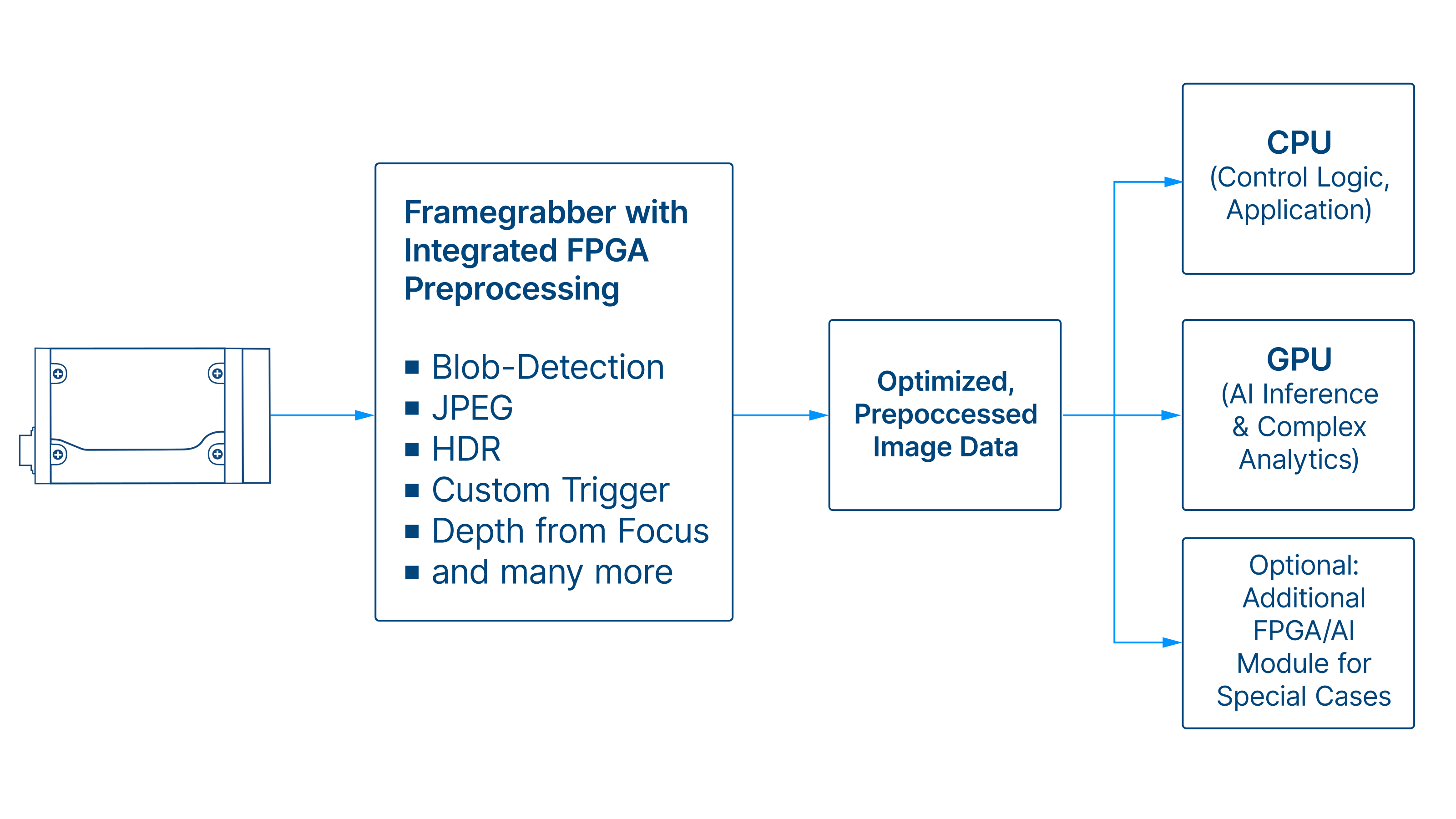
Programmable frame grabbers with integrated preprocessing based on FPGA technology handle computationally intensive preprocessing steps directly at the hardware level. Typical tasks such as color space conversion, HDR, distortion correction, defect pixel correction, shading correction, or look-up tables (LUTs) are executed in parallel with low latency. This significantly reduces the load on the CPU, allowing the GPU to focus on the actual inference and complex image analysis.
The result:
Significantly reduced latency and stable, reproducible results
Scalability even with growing data rates and number of cameras
Future-proof architecture thanks to FPGAs and VisualApplets
In practice:
The key to performance is the clever distribution of the computing load:
Hardware-level preprocessing on frame grabber and FPGA
Control and special cases on the CPU
AI inference on the GPU
The GPU excels at processing diverse image data, not primarily because of the volume of data, but because of the complexity and diversity of the data. Only through this optimized distribution can a powerful and future-proof architecture be designed for modern AI vision systems, reliably meeting demanding real-time requirements and standards in production environments.
Efficient image preprocessing with Data Reduction System
The large volumes of data generated by modern vision applications can be efficiently reduced to a manageable level through image data cleansing and image data reduction as part of image preprocessing.
Learn more about our Data Reduction SystemFrame grabbers effectively reduce CPU workload by capturing and preprocessing image data directly at the hardware level. FPGAs complement this system through individually programmable logic. They enable parallel, tailored data processing that efficiently accelerates neural networks. The result is increased overall performance, reduced latency, and thus stable, reproducible results in the production environment.

Measurable benefits of optimization with frame grabbers and FPGAs
Investing in optimized frame grabbers and FPGAs pays off not only in measurable performance but also saves real money over the 'system's lifetime through reduced hardware requirements, lower energy consumption, and better scalability.
Image preprocessing in machine vision in detail
Image preprocessing optimizes image data for specific application requirements, enhances image quality, offloads processing from the host PC, and streamlines the vision system. Learn more about the methods and typical applications for image preprocessing.
Knowledge article on image preprocessingCPU and GPU – tasks and strengths
In summary:
CPU: Versatile, flexible, few powerful cores, suitable for typical computing tasks and high-performing with complex individual operations.
GPU: Extremely parallel, many simple cores, specialized in massive data processing and for image processing, graphics, and artificial intelligence tasks.
In the AI vision system, the strengths of both components are deployed precisely where they offer the greatest benefit: CPUs for complex control and management tasks and GPUs for parallel, data-intensive computations.
Intelligent frame grabbers: Hardware acceleration and system integration
Faster processing thanks to reduced CPU and GPU workload: Modern frame grabbers with integrated FPGA technology handle preprocessing steps directly at the hardware level. This means that already optimized image data reaches the CPU and GPU, reducing the system load and enabling stable processing even at high frame rates and in multi-camera applications.
System integration
For integration into existing production environments, open, well-documented APIs and powerful development tools are essential. This allows the advantages of hardware acceleration to be seamlessly incorporated into individual image processing solutions. An efficient implementation of the frame grabber also ensures stable data transfer, precise synchronisation (especially in multi-camera systems), and reliable performance even at high frame rates.
Conclusion:
Intelligent frame grabbers with FPGA acceleration are a key factor for stable, scalable, and high-performance AI vision systems. They enable a clear separation between hardware-level preprocessing and software-side AI inference, ensuring maximum system efficiency.
Interfaces and bandwidth for efficient data transfer
Key technical factors
Efficient hardware design: Only optimally engineered frame grabbers make full use of the interface's maximum data rate. Internal signal processing, buffer architecture, and the speed of data transfer to the host computer determine whether the interface becomes a bottleneck.
Direct data paths and buffer management: High-quality frame grabbers rely on well-conceived memory and data management (e.g., DMA) to transfer image data without loss and with minimal latency. Weaknesses in this area lead to bottlenecks, data congestion, or even data loss, especially at high frame rates.
Synchronisation and timing: Precise trigger and timing management is essential, particularly in multi-camera systems. Inaccurate implementations cause image offset, packet loss, or inconsistent latencies.
Flexibility for different camera types: A modern frame grabber must reliably handle various camera types, formats, and timing requirements while ensuring stable, consistent data handover. This simplifies integration and increases system stability.
Risks of poorly optimized hardware / software
Loss or corruption of image data due to faulty buffer management or transmission paths
Increased latency and reduced frame rate caused by inefficient logic or poorly programmable drivers, a critical factor in real-time applications
Instability and compatibility issues, e.g. with PCIe cards, operating systems, or AI accelerators
Poor scalability once the system is expanded (more cameras, higher resolutions, increased frame rates)
Conclusion:
It is not the interface alone that determines system performance, but the quality of the frame grabber implementation and software integration. Only when hardware, buffering, synchronization, and drivers work together seamlessly does the overall system operate stably, reliably, and efficiently while remaining scalable even as data volumes grow.
Classic or programmable frame grabbers?
For AI vision systems, the choice between classic and programmable frame grabbers depends directly on the application, data rate, and complexity of preprocessing:
Classic frame grabbers — meaning cards without freely programmable logic or with only minimal hardware functionality — are suitable when the sole requirement is to pass raw data quickly and reliably to the CPU / GPU, with no need for special preprocessing, synchronization, or customizable trigger logic. They are sufficient for simple, stable setups without demanding real-time requirements.
Programmable frame grabbers with FPGA are highly effective in data-intensive, time-critical AI-based inline applications and complex production environments: they handle complex preprocessing directly on the hardware, reduce CPU and GPU workload, and enable flexible adaptation to new requirements. In multi-camera systems, applications with increasing resolutions, or environments with tight latency requirements, FPGA solutions offer significant performance and scalability advantages.
Conclusion:
For demanding, scalable AI vision systems, open software interfaces and programmable frame grabbers with an FPGA focus are the key to long-term flexibility and performance. We are happy to advise you on selecting and programming the right frame grabber for your application.
More about frame grabber and FPGA programmingFPGAs in detail: Tailored performance for AI vision
FPGAs are freely programmable logic devices that enable extensive parallel preprocessing of image data directly on the frame grabber.

With VisualApplets we go one step further: our no-code tool allows complex FPGA functions to be configured graphically, without specialised FPGA knowledge. You define your image processing visually, and VisualApplets automatically generates the optimized hardware logic. What makes it special: thanks to image-based simulation instead of tedious bit analysisyou can instantly see whether the result meets your requirements. This saves time, reduces complexity, and makes FPGA-accelerated image processing directly accessible.
Technical advantages in AI vision systems
Parallel processing of large image data volumes with minimal latency
Flexible adaptation to new algorithms and requirements through reprogrammability
Efficient offloading of CPU and GPU, particularly in inline inference, multi-camera, or high-speed applications
Targeted performance optimization for AI models through hardware adaptations such as quantization or specially optimized convolutional layers enables a precise implementation on the FPGA.
Significantly higher performance and lower latency in typical AI applications such as classification, object detection, and complex preprocessing pipelines
Conclusion:
Especially in AI-based production environments, FPGAs offer advantages in power density, low latency, and scalability. Despite higher initial costs, their energy efficiency, high system performance, and flexibility often provide long-term cost and competitive advantages.
Synergies between frame grabbers and FPGAs
Frame grabbers and FPGAs complement each other perfectly: while the frame grabber captures and transfers image data, the FPGA handles computationally intensive preprocessing steps directly in the hardware. This reduces CPU and GPU workload, reduces latency, and enables efficient, scalable data processing.
Practical applications and use cases
Inline quality control in electronics manufacturing
In automated inspection of printed circuit boards (PCBs), high-resolution cameras are combined with Basler frame grabbers. The FPGAs handle key tasks directly on the frame grabber:

Defect Pixel Correction, color space conversion, multi-ROI selection – directly at hardware level
Real-time error detection – even the smallest soldering defects, missing components, or short circuits
CPU offloading – serves only as an instruction unit
GPU for AI classification
Result:
Maximum inspection speed at minimal latency, even at high throughput rates and changing product variants.
Quality control in battery cell manufacturing
During the coating of battery electrodes, large material surfaces must be inspected with a high level of detail at production speeds of up to 80 m/min. Basler line scan cameras capture the coating, while frame grabbers and FPGA logic preprocess the image data during acquisition. This enables reliable defect detection without burdening the downstream image processing system with the full volume of data.
Hardware pipeline on the frame grabber:
ROI determination and preprocessing – selecting only relevant areas with irregularities
Reduced data volume – processing only these relevant image areas further
Deterministic processing – stable cycle times at high production speeds
AI-supported defect analysis on the GPU:
Defect classification – detecting faults such as agglomerates, cracks, contaminations, or voids
Precise measurement – determining the size and extent of defects within the ROIs
Qualified decisions – evaluating defects and reducing rejects in a targeted manner
Result:
Reliable quality control at high production speeds with significantly reduced data volumes, precise defect detection, and minimized material waste.
Visual inspection in food processing
In high-speed lines of the food industry frame grabbers with FPGAs are used to analyze large volumes of product images in real time.
Result:
Seamless quality control at extremely high belt speeds without throughput bottlenecks.